Saturday, September 27, 2014

Oddball EGA and VGA Resolutions, When the Standard Resolutions Aren't Used

I have already indicated in several posts that 320x200 was generally the resolution for DOS games.  However, in my previous post I discussed how the classic DOS pinball games use Mode X resolutions.  In this post I will identify other games that use non-standard resolutions.  While there are a few games that use oddball EGA resolutions, custom resolutions really came into play with VGA.  Once people figured out how to manipulate its CRT Controller Registers without destroying their monitors, all manner of resolutions became possible.

In addition to supporting all CGA Graphics and Text Modes and the MDA Text Mode, the standard BIOS Supported EGA graphics modes are :

Mode 0Dh - 320x200x16
Mode 0Eh - 640x200x16
Mode 0Fh - 640x350 mono (intended for monochrome MDA monitors)
Mode 10h - 640x350x16/64 (can display 16 colors from palette of 64 colors, requires color 350-line monitor)

In addition to supporting all the mode EGA supports, the standard, BIOS Supported VGA graphics modes are :

Mode 11h - 640x480x2 (intended for monochrome analog VGA displays, MCGA compatible)
Mode 12h - 640x480x16 (60Hz, all other VGA modes run at 70Hz)
Mode 13h - 320x200x256 (MCGA compatible)

For the list of games, I have taken my own screenshots with DOSBox.  Any aspect ratio correction from DOSBox has been removed.  If no scalers or aspect ration correction settings in DOSBox are used, 320x200, 320x240, 360x200 and 360x240 resolutions are not scaled.  Other resolutions are stretched as follows :

320x350 to 640x350
320x400 to 640x400
320x480 to 640x480
360x350 to 720x350
360x400 to 720x400
360x480 to 720x480

Certain resolutions, like 320x240, need no aspect ratio correction, since that mode was used to ensure square pixels.  Many of these modes may not fill to the edges of a VGA monitor.

Gauntlet

256x200 EGA Mode :


Gauntlet uses this mode, which seems derived from the 320x200 16-color mode.  Gauntlet and F-15 Strike Eagle also use an unusual for EGA 160x200 16-color resolution, but this may not be an actual new mode as just drawing every pixel twice in the 320x200 16-color mode.  Sierra's AGI games also use an effective 160x200 graphics resolution, but use the typical text font for the 40 column text modes, which require 320 horizontal pixels.

Lemmings & Oh No! More Lemmings

These games change the palette entries in mid-frame in order to select more colors than would be normally possible in the 640x350 16-color mode.  Lemmings uses this only for the screen type below, and no other place.  Regular DOSBox v0.74 will show these proper screens with the vgaonly machine type.

640x350x"32" EGA Mode :


640x350x"32" VGA Mode :


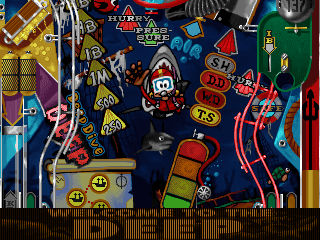
Pinball Fantasies

Same issue with Pinball Fantasies, but only on the table select screens and using a different resolution. Without this effect, the car would look mostly green.

640x480x"32" :


Pinball Illusions

Pinball Illusions is one of the most demo-like games ever released by a developer with any stature in the PC DOS game world of the time.  It uses several weird modes and very demo-like effects.

320x400 :


These graphics should obviously be stretched horizontally.

320x145 :


320x290 :


These banners should also be stretched horizontally to fill the screens, they look wrong without aspect ratio correction.

320x240 (304x224 active pixels) :


This screen is very interesting.  The active screen is 304x224 pixels, and this is what DOSBox captures in a screenshot.  On a real monitor, there is this dark blue border seen in the screenshot.  You can see this border in a custom version of DOSBox like daum that has border support.  I had to add the border in this screenshot, and I figured that 8 pixels on each side would ensure that the screen ratio was 4:3, those are rotating cubes.

Jurassic Park

This game is clearly an Amiga port.  One of the main game types uses an odd 320x184 mode.  I suspect that it was done for performance issues, as the same resolution is used for the Amiga.  The game uses 320x200 for the other game type, which is a first person 3D shooter.  However, the Amiga confines the action to a small window, whereas the DOS version the action takes up most of the screen.  Some Amiga screens use a 320x256 resolution (found on PAL Amigas), including the loading screen.  The loading screen shows a perfect circle, whereas the same screen in the DOS version, which uses 320x200 pixels, does not without aspect ratio correction.

320x184 :


Prehistorik 2

Why did the programmers decide to eliminate 8 pixels from the standard resolution?  Because they could, evidently.  Game uses 320x200 elsewhere, including on the in-game screen.  The difficulty selection screen shown below uses a typical demo effect.

312x200 :


Cyril Cyberpunk, a.k.a. Cyberboard Kid

288x224


No aspect ratio correction required.

Jazz Jackrabbit & Jazz Jackrabbit : Holiday Hare '94 & '95

320x199 :

I hypothesized earlier that the programmers made a tiny tweak to the standard mode to ensure that the adapter would run this mode at 60Hz, not the default 70Hz. The question of whether the game requires aspect ratio correction is complex.  The in-game screens clearly do not :


If you look at the circles in the last two screenshots, you can see that they are perfectly circular.  Aspect ratio correction would only stretch them into ovals.  Similarly, the large and small "diamonds" in the first two screenshots are actually squares, as each of the four sides has the same length.  In fact, on a real VGA CRT, the in-game graphics should appear in a letterbox mode with large borders on the top and bottom.  However, if the user decides to stretch out of screen vertically, then the objects will become elongated.  There are no other near modes that would show the detrimental effects of the stretch, so the effect may be lost.  

On the other screens, some may require aspect ratio correction, while others do not.  Here is one that does not :


On the other hand, this one does :


The planet in the middle of the screen doesn't look quite right without aspect ratio correction.  Even with aspect ratio correction, its not a perfect sphere, but neither is the real Earth :


The Incredible Machine & The Even More Incredible Machine

Sierra bought several companies in the early to mid-1990s, and while their own games rarely pushed hardware, the same cannot be said for some of its subsidiaries, like the one that produced this series of games.  These games do not require aspect ratio correction.

640x471x16 :


640x400x16 :


640x448x16 :


The Incredible Machine 2

640x441x16 :


Quake

Quake is unique because it supports every combination of 320 and 360 horizontal pixels and 200, 240, 350, 400 and 480 vertical pixels.  Increasing the vertical resolution increases the view area vertically.  This looks absolutely ludicrous without aspect ratio correction once you get to 350 vertical pixels.  Increasing the horizontal resolution puts empty filler on the sides of the status area and does not enhance the field of view horizontally.  Instead, it merely stretches the pixels contained within that view horizontally.  I would personally recommend staying with the 320x240 resolution.  At 640x480 resolutions, you should really be using GLQuake (with a Glide wrapper if necessary) or a source port with support for more modern 3D accelerators.

320x240 :


320x350 :


320x400 :


320x480 :


360x200 :


360x240 :


360x350 :


360x400 :


360x480 :


Earthworm Jim & Earthworm Jim 2

Earthworm Jim was originally designed for the Sega Genesis, which uses a 320x224 pixel resolution.   320x240 is used for all non-ingame screens in both EWJ1 and EWJ2.  Both 320x224 and 320x240 are available for EWJ1 in-game, but EWJ2 supports only 320x224.  There is no difference between the two graphics modes in EWJ1 except the need to adjust the size graphics using the monitor controls, but some cards had trouble with the 320x224 mode.  Due to the origins of this game, it should be stretched out vertically, but tiny difference between 224 and 240 pixels makes it pretty much a non-issue.

320x240 :


320x224 :


The Lost Vikings & Norse by Norse West: The Return of the Lost Vikings

320x240 :


LineWars II

This is the only Mode X VGA mode the game supports, and it requires horizontal stretching.  This game will support 640x480 and 800x600 on specific ATi and S3 SVGA cards.  The regular 320x200 resolution does not need aspect correction, but the 320x480 resolution obviously does :

320x200 :


320x480 :


Scorched Earth

For the main menu, each increase in the graphics resolution adds more height to the image.  As a consequence, the buttons are more spaced out vertically.  However, as you can see, the 320x240 resolution cannot fully display all the buttons using the spacing, which is consistent beginning with this resolution.

320x200 :


320x240 :


320x400 :


320x480 :


360x480 :


As far as the in-game graphics go, each increase in resolution substantially increases the play area, but not the status bar.  As you can see, the amount of barrier to open space ratio eventually becomes ridiculous :

320x200 :


320x240 :


320x400 :


320x480 :


360x480 :


Aspect Ratio correction required.

Chaos Software Mario Shareware Game

320x190-191 :


The top eight pixels do not seem to be used, but sometimes an extra black line is displayed, leading to the one pixel difference.

Axia

640x400x16 :


Needs no aspect ratio correction, the planets are perfectly spherical without it.

Jump 'n Bump

400x256 :


Most Moraff games

Games shown are Moraff's Flygame, Moraff's Super Entrap and Moraff's Monster Memory

360x480 :


Monster Memory's unadjusted 360x480 resolution is clearly wrong compared to its true 4:3 SVGA modes, which show perfect squares.  In addition, the 320x200 mode does not show perfect squares unless aspect ratio correction is applied.  I would think this applies to all of Steve Moraff's games, since they were developed by him.

I am greatly indebted to RGB Classic Games for identifying many of the more obscure games on this list. Moraff's (Regular) Entrap and Magic Pockets do not use a 640x400 VGA mode, despite what RGB Classic Games may think.  Moraff's Entrap, as it states in its setup menu supports EGA 320x200, EGA 640x350, VGA 320x200 and VGA 640x480.  Magic Pockets supports regular EGA 320x200 (but uses different palette entries than the Tandy 320x200 mode) and regular VGA 320x200.

The Moraff games that support the 360x480 mode are as follows :

Moraff's Blast I
Moraff's Dungeons of the Unforgiven, Module I
Moraff's Monster Bridge
Moraff's Monster Memory
Moraff's Super Blast
Moraff's Super Entrap
Moraff's Mega Morejongg
Moraff's Stones
Moraff's World

Moraff's Escapade only supports OEM-specific SVGA modes found on Ahead Systems, Trident and Tseng Labs chipsets with 1MB of RAM.

System Shock CD

Unlike the floppy version, which supports only 320x200, the CD version also supports 320x400, 640x400 and 640x480.  While the 320x400 resolution clearly requires aspect ratio conversion, the 320x200 and 640x400 modes do not.  They have perfect squares and circles in the HUD area, and the 640x480 mode distorts them into rectangles and ovals.

320x200 :


320x400 :


Conclusion

I believe there are to types of non-standard VGA modes, first there are the the modes that use a combination 320 or 360 horizontal pixels and 200, 350, 400 or 480 vertical pixels.  Second, there are modes that use a number of pixels other than the ones given in the previous sentence for at least one axis.  The second variety are the games that tend to break graphics cards with less than stellar VGA compatibility.  Even the first variety can cause later cards to break because there was no universal standard.  

As far as aspect ratio correction with non-standard VGA modes go, it is almost always desirable to stretch out the double the horizontal pixels for any of these games that use a 320 or 360 horizontal pixel resolution.  Often, there will be a standard VGA or SVGA mode to guide you.  I understand that VGA cards more or less do this by default in low resolution modes.  However, this does not always apply, as I have demonstrated in the previous post with the 360x350 mode used by Pinball Dreams and its successors.  

With games that use a high resolution 16 color mode with 640 horizontal pixels, I see no reason to stretch the display vertically.  The letterboxing is pretty minimal.  

Thursday, September 25, 2014

Classic DOS Pinball Games, Mode X and What they can Teach Us about Aspect Ratios

During the early to mid 1990s, several highly regarded pinball games were released for PC compatible computers running DOS.  Three prominent series of Pinball games were released during the years 1992-1995.  The first, developed by Digital Illusions, includes Pinball Dreams (1992), Pinball Fantasies (1992) and Pinball Illusions (1995).  All these were developed on the Commodore Amiga and ported to the PC by Frontline Designs.  The second series was developed by Epic Megagames, and consists of Epic Pinball (1993), Silverball (1993) and Extreme Pinball (1995).  A third series was developed by Spidersoft, and includes Pinball Dreams II (1994), Pinball Mania (1995) and Pinball World (1995).  There are also a few other notable pinball games that are not distinguished by coming from a single developer or publisher around this time.  These include Psycho Pinball (1995) and Absolute Pinball, which share the same style of gameplay as the other titles.

These games always supported non-standard VGA modes, sample-based music and were often heavily influenced by the demo-scene and European programmers who were still focused on the Commodore Amiga.  They all used an in-game display that used the full width of the screen and most of its height, with a portion of the height reserved for a display.  The tables were much taller than one screen could display.  They did not use a pseudo 3-D perspective, but all supported a high frame rate for fast, exciting action.  Most supported the Gravis Ultrasound as the ideal sound output device.

There has been debate over the proper aspect ratio for DOS games using the standard 320x200 resolution.  That resolution, as I outlined in a previous post, was a BIOS standard resolution for no less than the five (out of seven) major DOS game graphics display adapters, CGA, TGA, EGA, MCGA and VGA.  Using square pixels, the aspect ratio is 1.6:1, and this gives a letterbox effect on standard 4:3 ratio CRT monitors at the time.  If you stretch the monitor vertically, you can fill the screen but the pixels become 1.2 times as tall as they are wide.

VGA BIOS Display Mode 13h, which most VGA DOS games used, used the 320x200 resolution with an ability to display 256 colors from a palette of 262,144 colors.  The pixel information for the graphics is stored sequentially, with one pixel = one byte.  However, in addition to the aspect ratio issue, Mode 13h had its limitations, namely the fact that it could only support one full page of graphics in RAM.

A VGA card has 256KB of RAM, so the card could support four graphics pages at this resolution.  However, to do this, the card's registers had to be programmed directly.  Also, the registers that made up the display resolution could also be changed, but the values had to be reasonable lest the programmer destroy his or his user's monitors.  VGA, in its various official modes, supported 320, 360, 640 or 720 horizontal pixels and 200, 350 or 480 vertical pixels.  240 and 400 vertical pixels could be easily obtained by writing to a few registers.

Mode X, a custom VGA mode obtained by programming the registers, canonically has a 320x240 resolution at 256 colors.  The term eventually became to be appropriated for any non-standard resolution VGA mode.  320x240 was very popular for the pinball games identified above.  It is especially useful to obtain a reference for what the graphics should look like with square pixels.  Other modes like 320x350, 320x400, 320x480 and 360x480 were also popular, especially with shareware games.

360x480 at 256 colors was the maximum resolution a programmer could hope to achieve with 256KB VGA and keep to some degree of compatibility.  While it may have the RAM to display a 640x350 or 640x400 resolution at 256 colors, other technical limitations on the VGA prevent it from doing so.  Any graphics displaying in 640x350x256, 640x400x256 or 640x480x256 is always using some kind of SVGA or VESA mode.

DOSBox will stretch certain modes horizontally and this functionality cannot be totally disabled.  If no scalers in DOSBox are used, 320x200, 320x240, 360x200 and 360x240 resolutions are not scaled.  Other resolutions are stretched as follows :

320x350 to 640x350
320x400 to 640x400
320x480 to 640x480
360x350 to 720x350
360x400 to 720x400
360x480 to 720x480

If a screenshot is taken of any of the horizontally-stretched modes, the stretch effect can be removed by reducing the horizontal resolution by half using nearest neighbor interpolation.  This will eliminate every second column of pixels.  Resizing by doubling the horizontal resolution using nearest neighbore interpolation will restore those pixels.  In the screenshots below, I have eliminated any stretching by this method.

Digital Illusions' Pinball Series

Pinball Dreams and Pinball Fantasies offer two resolutions, 320x200 and 320x350.  Take a look at these screens from each game :

Pinball Dreams 320x200
Pinball Dreams 320x350
Pinball Fantasies 320x200
Pinball Fantasies 320x350
Both modes give the same amount of screen area to the status display, only the text is off-center (in relation to the status display area), in the 320x350 mode.

The great advantages of pinball games is that they almost always have a ready supply of circles which you can judge whether the aspect ratio is correct.  If a circular object looks like its diameter is the same regardless of the points of the circle measured, you are on sure ground to assume that the aspect ratio is correct.  If the object looks like the diameter is shorter between certain points compared other points, looking more like an oval, then the aspect ratio is probably incorrect.

For Pinball Dreams and Fantasies, the only difference between the 320x200 and 320x350 graphics is that the 320x350 graphics show 1.75x more of the pinball table.  Pinball tables, by their very nature, tend to be much taller than they are wide.  This will be an important point when I go on to discuss the final game in this series, Pinball Illusions.  However, this is what DOSBox displays in the 320x350 mode :

Pinball Fantasies Stretched
The game does not give the pixel dimensions of its high resolution mode in numbers.  However, comparing the two screenshots, it is apparent that no extra detail is given in the stretched screenshot.  Instead, the pixels are much more prominent and the circular objects have become ovals.  It should be clear that stretching is not correct for this mode.

If any further confirmation is required, look to the original games for the Commodore Amiga.  Pinball Fantasies (OCS/ECS PAL version) for that system uses an effective 320x262 resolution.

Pinball Fantasies Amiga OCS/ECS
Pinball Illusions is by far the most demo-scene inspired of these three pinball games, using numerous odd-ball resolutions in its pre-game sequences.  However, for VGA cards, the pattern is almost the same.

Pinball Illusions 320x240
Pinball Illusions "360"x350 (only 336 horizontal pixels used)
If you look carefully, you can see that the right side of the screen is slightly cropped in the 320x240 mode compared to the "360"x350 mode.  The SVGA/VESA Modes follow the 360x350 mode, but only the vertical resolution is increased :

Pinball Illusions "640"x480 (only 336 horizontal pixels used)
Pinball Illusions "800"x600 (only 336 horizontal pixels used)
By the time you get to 800x600 pixels, the screen barely needs to scroll, you can see almost the whole table. On a real CRT monitor, these tables will appear centered in a narrow portion of the middle of the screen with large black borders on either side.  For all these pinball games, no stretching should be done.  If necessary, you should decrease the horizontal size on your CRT monitor until the circular objects look like circles.

Epic Megagames Pinball Series

For the first two games in Epic's series, Epic Pinball and Silverball, they are easy to deal with because they each only use a 320x240 resolution for their tables.  

Epic Pinball 320x240
Silverball 320x240
For the final game, Extreme Pinball, it only uses a 320x400 resolution, and the situation is quite different.  

Extreme Pinball 320x400
As you may have noticed, the ball and the chutes do not look like spheres.  If we stretch this resolution, we get the following : 

Extreme Pinball "640"x400

Now the ball and chutes look like spheres.  Therefore, for one set of games, stretching is not desirable, but for this game, it is.

Spidersoft Pinball Series

Pinball Dreams II was intended as the sequel for Pinball Dreams even though Spidersoft had no connection to Digital Illusions.  Since it was built using the same engine, the same graphical issues appear in it.  Pinball Mania uses the same graphics modes as Pinball Fantasies, and the same comments apply.  In short, they all look correct at their native aspect ratios, no adjustments or stretching required :

Pinball Dreams II 320x200
Pinball Dreams II 320x350
Pinball Mania 320x240
Pinball Mania 320x350
Pinball World uses a standard 320x200 mode or a 320x240 mode.  However, the ball is perfectly "circular" in the 320x200 and 320x240 modes (15x15 pixels) without any aspect ratio correction.  Unlike the earlier pinball games, Pinball World uses huge tables that are wider and taller than the screen resolution.  The ball is the same size in both modes, so the higher resolution just shows more of the table :

Pinball World 320x200
Pinball World 320x240
Other Pinball Games

Although Psycho Pinball uses a 320x240 or an odd 320x368 resolution, it follows the same pattern as Pinball Dreams.  The extra resolution merely shows more of the table, although this time more of the status bar is displayed.  No stretching should be done to its graphics.


For the final game to be detailed in this blog post, Absolute Pinball, the comments made for Psycho Pinball apply.  It offers three modes, 320x240, an odd 360x270 mode and a 320x400 mode.  First, the usual modes :

Absolute Pinball 320x240
Absolute Pinball 320x"400" (only 384 vertical pixels are used)
Like Psycho Pinball, the 320x400 resolution merely adds more visibility to the table and a larger dstatus display.  The circular objects are circular without any stretching.  For the 320x400 resolution, this is in marked contrast to Extreme Pinball, which uses the same resolution.  Last, let's consider the oddball 360x270 resolution.

Absolute Pinball "360"x270 (only 320 horizontal pixels are used)
First, despite the larger number of horizontal pixels offered by the mode, only the middle 320 pixels are used.  The status display uses a 320x62 pixel box.  This is essentially the size of the status display in the 320x400 mode.  The purpose of this mode was to allow for the same status display as enjoyed by users of the highest display resolution with more modest system requirements instead of the smaller status display.  Again, no particular stretching is required for this mode.  

Monday, September 22, 2014

Nintendo Power - When they Got it Right and When they Got it Wrong

When the NES was released, video game journalism did not exist.  Nintendo Power became a hugely popular magazine and practically required reading for NES players.  One did not use it like a movie review column, which would tell you which films were worth seeing and which were worth skipping.  Instead, you subscribed to the magazine to find out about the hottest new games that were to be released.  Nintendo Power began to assign ratings to games with Issue 5, but the ratings were a joke.

I remember salivating over all the great games revealed in its pages every other month.  Most of the time, Nintendo Power gave proper coverage to those games that deserved it.  A game with a cover or a feature indicated, usually, a certain level of quality.  Some games were overlooked, and in this blog I will offer a tip of my hat when the classics are given their due and a wag of my finger when they are not.  I will start by briefly going through the Nintendo Fun Club News and then proceeding to the issues of Nintendo Power published in 1988 and 1989.  During this period, all games with a cover were genuine classics (with one exception), and the coverage gravitated toward good to great games far more often than not.

Nintendo Fun Club News, Issue 1, Winter 1987

Game(s) on Cover : None

Game(s) on Cover : None

Featured Games : Super Mario Bros., Excitebike, Hogan's Alley

Previews : Pro Wrestling, Slalom

Comments : The NES was released in October, 1985 in test markets and nationwide in 1986.  By the end of 1986, the console had been sufficiently successful that Nintendo could put out a newsletter


Nintendo Fun Club News, Issue 2, Summer 1987

Game(s) on Cover : None

Featured Games : The Legend of Zelda, Volleyball, Slalom, Pro Wrestling, Super Mario Bros.

Previews : Metroid, Kid Icarus

Product Feature: NES Advantage

Comments : There is not much to say about issues 1 and 2, they function more as advertisements for games rather than detailing strategy, displaying maps and giving hints and tips.  Nintendo released "Hot to Win at Super Mario Bros." and "The Legend of Zelda - Tips & Tactics" booklets around this time.


Nintendo Fun Club News, Issue 3, Fall 1987


Game(s) on Cover : The Legend of Zelda

Featured Games : Metroid, Kid Icarus

Previews : Mike Tyson's Punch-Out!!, Rad Racer, R.C. Pro-Am, Zelda II: The Adventure of Link

Product Feature: NES Advantage

Comments : Issue 3 is the first issue with a full-page artwork cover.  There will be many repetitions of featured games.  Nintendo was featuring games it was publishing at the time.  Nintendo published games developed by third party developers like Rare (R.C. Pro-Am), Square (Rad Racer) and Irem (Kung Fu).  Advertisements for third party games begin to appear in Issue 3

Nintendo Fun Club News, Issue 4, Winter 1987

Game(s) on Cover : Mike Tyson's Punch-Out!!

Featured Games : Rad Racer, The Legend of Zelda

Previews : Zelda II: The Adventure of Link, Dragon Warrior

Product Feature : Hands-Free Controller

Comments : Issue 4 would begin Nintendo's magazines' long love affair with Zelda II, but Dragon Warrior would not arrive on U.S. shores for almost two years.  The Nintendo Hands-Free Controller was eventually released, but in a more streamlined design.


The Official Nintendo Player's Guide, 1987

Featured Games : The Legend of Zelda, Mike Tyson's Punch-Out!!, Commando, Super Mario Bros., Ghosts 'N Goblins, Top Gun, Double Dribble, Zelda II: The Adventure of Link, Metroid, Rad Racer, Ring King, Gradius, Kid Icarus, Pro Wrestling, Castlevania, Excitebike, Arkanoid, Rush 'N Attack, Donkey Kong, Rygar, Spy Hunter, The Goonies II, Ikari Warriors, Kung Fu

Capsule Reviews : Deadly Towers, Baseball, Golf, Soccer, Slalom, Tennis, 10 Yard Fight, Volleyball, Winter Games, M.U.S.C.L.E., Family Fun Fitness, Stadium Events, Tag Team Wrestling, Karate Champ, Side Pocket, Lunar Pool, Track & Field, Pinball, Balloon Fight, Ice Climber, Urban Champion, Clu-Clu Land, Star Voyager, 3-D Worldrunner, Tiger-Heli, Super Pitfall, Chubby Cherub, Ninja Kid, Spelunker, Stinger, Raid on Bungeling Bay, 1942, Trojan, Section Z, Mega Man, Kid Niki, Breakthru, Karnov, Zanac, Sqoon, Jaws, The Karate Kid, Athena, Alpha Mission, Sky Kid, The Legend of Kage, Renegade, Mighty Bomb Jack, Solomon's Key, Hogan's Alley, Duck Hunt, Gumshoe, Wild Hunman, Gotcha!, Mach Rider, Wrecking Crew, Lode Runner, Mario Bros., Donkey Kong Jr., Popeye, Donkey Kong 3, Burgertime, Elevator Action, Gyromite, Stack-Up, Donkey Kong Jr. Math

Comments :  This publication was much thicker than the Fun Club News issues, and had the ambitious task of "reviewing" every game available for purchase for the NES as released from October 1985 through December, 1987.  When I say "reviewing", I do not mean giving a critical review of the game title but a description of the game in an advertising friendly format.

Games that should have been relegated to the Capsule Reviews sections, in my opinion, include Commando, Top Gun, Ring King, Donkey Kong, Spy Hunter, Ikari Warriors and Kung Fu.  Commando is too repetitive and buggy, Top Gun and Ring King aren't great, and Ikari Warriors and Spy Hunter are poor arcade game conversions.  While classics, Donkey Kong and Kung Fu are too simple for the pages they take up.  I would have instead have given the following games full reviews : 3-D Worldrunner, Ice Climber, Trojan, Mega Man, Wrecking Crew, Zanac and maybe Renegade or Kid Niki.  Mega Man and Zanac are classics that were Criminally Overlooked (Nintendo eventually righted this wrong with Mega Man), Trojan is pretty good for an early Capcom game, and Ice Climber and Wrecking Crew are two pre-SMB Nintendo Classics.

Even in 1987, the number of crap games is fairly disturbing, and many games from the early period simply haven't aged well (most of Nintendo's early sports titles).  The NES would have been better served if garbage like Deadly Towers, Star Voyager, Urban Champion, M.U.S.C.L.E., Super Pitfall and Athena were never released.  Arcade ports were in many cases, Karnov, Spy Hunter, Ikari Warriors, Karate Champ, 1942 rather uninspired.

Nintendo Fun Club News, Issue 5, Feb/March 1988

Game(s) on Cover : R.C. Pro-Am

Featured Games : Ice Hockey, Mike Tyson's Punch-Out!!, The Legend of Zelda, The Goonies II

Previews : Zelda II: The Adventure of Link, Super Mario Bros. 2, Return of Donkey Kong (never released), U.S. Golf (eventually released as NES Open Tournament Golf)

Product Feature : NES Max

Comments : First issue to feature a game published by a third-party developer, Konami's Goonies II.  One of the greatest NES games ever, Contra, was released in February, but you would hardly know about that by reading this magazine.  Criminally overlooked during the transition from the Fun Club News to Nintendo Power.  I like Metroid-style games like The Goonies II alot.

Nintendo Fun Club News, Issue 6, April/May 1988

Game(s) on Cover : Zelda II: The Adventure of Link

Featured Games : Double Dragon, Mike Tyson's Punch-Out!!, The Legend of Zelda

Previews : Super Mario Bros. 2, U.S. Golf

Comments :  Technos' Double Dragon NES port first rears its infamous head in this magazine, there were many better games that could have been featured.


Nintendo Fun Club News, Issue 7, June/July 1988

Game(s) on Cover : Sports Wrap-up 1988 -  Ice Hockey, Rad Racer, R.C. Pro-Am, Pro Wrestling, Mike Tyson's Punch-Out!!

Featured Games : Metroid, Wizards & Warriors

Previews : Super Mario Bros. 2

Comments :  Five of the best sports games for the NES are on the cover.  Wizards and Warriors was a bit too easy because it had infinite continues, but is still a fun game.  This was the end of the Nintendo Fun Club News magazine, its successor, Nintendo Power, would be much larger and better.  More and more third party games were being released, so Nintendo's first party and published titles need not have to carry so much of the slack.

All the covers for and most of the featured games in the Nintendo Fun Club News were classics.

Nintendo Power, Issue 1 - July/August 1988

Game(s) on Cover : Super Mario Bros. 2

Featured Games : Legend of Zelda, Double Dragon

Now Playing : Gauntlet, Contra, Wheel of Fortune, Jeopardy, R.B.I Baseball, Bases Loaded & Major League Baseball

Video Shorts : Legendary Wings, Iron Tank, Gun.Smoke, Rambo, Dragon Power, Metal Gear, Bionic Commando, City Connection, Ikari Warriors II: Victory Road, Star Force, Freedom Force

Poster : R.B.I Baseball, Bases Loaded & Major League Baseball

Howard & Nester : The Legend of Zelda

Comments : Super Mario Bros. 2 was huge at the time, and Double Dragon was a something of a classic even if it wasn't especially true to the arcade.  The arcade game was especially difficult for home console and computer ports to capture.  While classics like Metal Gear and Bionic Commando are relegated to the shorts section, they would get their due in later issues (and Metal Gear came with a map in the box). Contra's relegation to four pages in the Now Playing section utterly failed to do that game justice.  Its a much better arcade port than Double Dragon, in fact, it may be one of those rare games where the home console version is better than the arcade original.

Nintendo Power, Issue 2 - September/October 1988


Game(s) on Cover : Castlevania II: Simon's Quest

Featured Games : Bionic Commando, Life Force, Super Mario Bros. 2, Renegade, R.C. Pro-Am

Now Playing : Golgo 13, Blaster Master

Video Shorts : Xenophobe, Seicross, Superman, Indiana Jones and the Temple of Doom, Lee Trevino's Fighting Golf, 1943, Jackal, Hudson's Adventure Island, Magmax, Donkey Kong Classics, Pac-Man, Defender, Millipede, Joust, Xevious, Galaga

Poster : Bionic Commando

Howard & Nester : Super Mario Bros. 2

Product Feature : Power Pad

Comments : The featured games are all classics (Bionic Commando, Life Force, SMB2) or at least very good (Renegade, R.C. Pro-Am) for their time.  While the AVGN (back when he was the Angry Nintendo Nerd) began his Internet career with a roast of Castlevania II, I still believe it is a very good game despite its flaws.  The graphics and sound are first rate, the open world is vast and the item collection and multiple endings by game time completed are obviously inspired by Metroid.  The stiff controls, enemy hit bounce back, easy bosses and losing all your hearts when you lose your third life.

Like many games to come, Nintendo spread out its coverage of SMB2 into two magazines.  There is alot of crap in the shorts this month, but a classic like Jackal or a very good game like 1943 should have been in the Now Playing section over the middling Golgo 13.  Most of the classic arcade ports are pretty decent, or very good (Donkey Kong, Galaga).

Nintendo Power, Issue 3 - November/Decembet 1988

Game(s) on Cover : Track & Field II

Featured Games : Mickey Mousecapade, Blaster Master

Now Playing : Ultima: Exodus, Legacy of the Wizard, Anticipation, Blades of Steel, Cobra Command, Racket Attack

Video Shorts : Bubble Bobble, Paperboy, Ghostbusters, Tecmo Baseball, Challenge Pebble Beach, Dr. Chaos, Tecmo Bowl, Platoon, Milon's Secret Castle

Poster : Blaster Master

Howard & Nester : Castlevania II: Simon's Quest

Product Feature : NES Advantage & NES Max

Comments : I am no expert on sports games, but if one had to be featured, it is best that it is a Konami title.  I like Mickey Mousecapade more than its reputation would suggest.  Its fairly difficult for a child-oriented game.  Cobra Command should have sent to the shorts section and Bubble Bobble put in its place.  

I have used both the NES Advantage and the NES Max, and I am not particularly found of either.  While I appreciated the trubo fire for Contra, the Advantage's joystick was too imprecise for many games and the buttons could stick.  The circle thing on the Max was not nearly as useful as the features made it out to be.

Nintendo Power, Issue 4 -  January/February 1989

Game(s) on Cover : Zelda II: The Adventure of Link

Featured Games : Wrestlemania, Sesame Street 1-2-3, Skate or Die

Now Playing : Marble Madness, Operation Wolf, John Elway's Quarterback, N.F.L. Football, Tecmo Bowl, Metal Gear

Video Shorts : Friday the 13th, World Games, Star Soldier, Dr, Jekyll and Mr. Hyde, Bump'n Jump, Rampage, Othello, RoboWarrior, Spy vs. Spy, Gyruss, Q-Bert

Poster : Skate or Die

Howard & Nester : Track & Field II

Product Feature : Hands Free Controller, Playchoice-10

Comments : In case Nintendo hadn't covered it enough, this is the first of two features for Zelda II. In my opinion, there are exactly two good wrestling games on the NES, one had been released early in the console's life, and Wrestlemania is not the other one.  I know the WWF was big at the time, but the game sucks.  In addition, two out of three of the football games also suck, but Tecmo Bowl more than makes up for them.  Skate or Die, World Games and Spy vs. Spy were better on the C64.  All-in-all a slow pair of months, which is probably why Zelda II got the cover.  

The Hands Free Controller got a redesign, and its actually fairly usable in practice.  Its certainly no harder to use than the Power Glove or the U-Force.  You can watch a video of it being used here : https://www.youtube.com/watch?v=SKzKp3QGg6M

Nintendo Power, Issue 5 -  March/April 1989

Game(s) on Cover : Ninja Gaiden

Featured Games : Zelda II: The Adventure of Link, Hudson's Adventure Island

Previews : Strider, Teenage Mutant Ninja Turtles, Cobra Triangle, The Adventures of Bayou Billy

Video Shorts : World Class Track Meet, Dance Aerobics, Super Team Games, California Games, Taboo : The Six Sense, Nobunaga's Ambition, Desert Commander, Mappyland, Airwolf, Predator, Flying Dragon

Poster : Strider

Howard & Nester : Zelda II: The Adventure of Link

Product Feature : None

Comments : A classic game in Ninja Gaiden, another two part feature.  Hudson's Adventure Island seemed a bit dated by the time it was featured.  The shorts were mostly deserved, but Desert Commander is a decent wargame for the time.  The Koei strategy titles were intimidating and boring back then and have aged very poorly.  

Nintendo Power, Issue 6 -  May/June 1989

Game(s) on Cover : Teenage Mutant Ninja Turtles

Featured Games : Ninja Gaiden, The Adventures of Bayou Billy, Cobra Triangle, Life Force

Previews : Mega Man II, Faxanadu, Fester's Quest, Clash at Demonhead, Dragon Warrior

Video Shorts : Super Dodge Ball, Bugs Bunny's Crazy Castle, Fist of the North Star, Kung Fu Heroes, Street Cop, Athletic World, Amagon, Monster Party, Adventures of Lolo, Hydlide

Poster : Mega Man II

Howard & Nester : Ninja Gaiden

Product Feature : None

Comments : TMNT is one game that did not deserve its vaunted status as one of the top ten bestselling NES games.  The game is a flawed effort from Konami, but not without its redeeming features. Unfortunately, its merciless difficulty earned it a reputation as black as its box.  Its biggest sin, in my opinion, is that it didn't have the same feel and tone as the ultra-popular cartoon series of the time.  Fortunately, Konami would improve its TMNT licensed games for the next two games in the series.  

Another Konami game crippled by the difficulty was The Adventures of Bayou Billy.  Unlike Golgo 13, this game did two out of three of its gameplay types well.  Unfortunately, the main gameplay type, the side-scrolling beat-em up, is plagued by stiff controls, too few moves and too many palette swapped enemies.  Life Force is the best Konami game in this issue, and it was already featured back in Issue 2.

Super Dodge Ball, despite slowdown and flicker, deserved better than the video shorts section, as did Adventures of Lolo, Kung Fu Heroes and Monster Party.  Interestingly, there is a "HOT" label next to the listing for Mega Man II in the table of contents, indicating that the editors knew something good was coming. The poster included would also tend to suggest this.

Nintendo Power, Issue 7 -  July/August 1989

Game(s) on Cover : Mega Man II

Featured Games : Faxanadu, Dragon Warrior, Strider

Previews : Robocop, Duck Tales, Who Framed Roger Rabbit, Ironsword: Wizards and Warriors II

Video Shorts : Bad Dudes, The Adventures of Tom Sawyer, Guerrilla War, Defender of the Crown, King's Knight, To The Earth, Shooting Range, Sesame Street ABC, The Adventures of Dino-Riki

Poster : Robocop

Howard & Nester : Teenage Mutant Ninja Turtles

Product Feature : Nintendo Game Boy

Comments : Few better games were ever released for the NES than Mega Man II.  Dragon Warrior was a classic and extremely important for JRPGs, but the first game plays like a cross between Wizardry and Ultima II.  The extremely stingy awards of experience and gold made the game far, far longer than it had any right to be, which was essentially the norm of 1980s RPGs, console and computer alike.  Strider is kind of buggy and no patch on the arcade game, but it is interesting in its own right.  Guerrilla War, which like Ikari Warriors was released by SNK, is a great game that deserved a Feature.  Criminally overlooked, and better than all three Ikari Warriors games for the NES combined!  Interestingly, To The Earth was a Nintendo published game, but still relegated to the shorts section.

This issue is the first issue to feature a new Nintendo console, the hand-held Nintendo Game Boy.  In its own way, the Game Boy would be at least as important as the NES for video gaming history.  

Nintendo Power, Issue 8 -  September/October 1989

Game(s) on Cover : Duck Tales

Featured Games : Dragon Warrior, Hoops, Fester's Quest, Who Framed Roger Rabbit

Previews : Willow, River City Ransom, Batman, NES Play Action Football, Tetris (Game Boy)

Video Shorts : Air Fortress, Bad Street Brawler, Casino Kid, Castlequest, One on One, Romance of the Three Kingdoms, Sky Shark

Poster : Batman

Howard & Nester : Mega Man II

Product Feature : Nintendo Game Boy, NES Satellite, NES Cleaning Kit

Comments : Although perhaps not universally acknowledged as such, Duck Tales is a great game made by the team responsible for the Mega Man series.  The game captures the spirit of the cartoon perfectly, the graphics are colorful and cartoon-like, the music is brilliant and the levels are well-designed.  The only knocks against it are the too liberal hit detection and the awkward pogo control scheme.  Its easily better than any of the other featured games.  Fester's Quest and Roger Rabbit are both deeply flawed, but far from worthless, games.  Roger Rabbit does much better than Fester's Quest at capturing the spirit of the licensed material. 

For all those gamers who blew on their consoles to get their games working, advertised here was the NES cleaning kit.  Foolishly, the kit tells the user to use water instead of alcohol to clean the contacts.  Water corrodes contacts, isoprophyl alcohol does not.  

The NES Satellite saw its first mention, and its first supported game was NES Play Action Football. Relatively few good four player games were ever released.  M.U.L.E. may be the best of the bunch, even if it has some gameplay differences from its home computer originals.  Bomberman II is a good game and supports three players and Nintendo World Cup may be the best soccer game for the NES.

Nintendo Power, Issue 9 -  November/December 1989

Game(s) on Cover : Tetris (Game Boy)

Featured Games : Willow, Tetris (NES), Ivan Stewart's Super Off-Road, Ironsword: Wizard & Warriors II, Robocop, N.E.S. Play Action Football

NES Previews : Wheel of Fortune Jr., Jeopardy Jr., The Three Stooges, Stealth Eagle, Godzilla, Shadowgate, Silent Service, A Boy and His Blob, 720°, The Guardian Legend

Game Boy Previews : Super Mario Land, Revenge of the Gator, Castlevania - The Adventure, Motocross Maniacs, Tennis, Baseball, Alleyway

Video Shorts : Goal!, Thundercade, P.O.W., Twin Eagles, Back to the Future, 

Product Feature : Power Glove, U-Force

Comments : For the last issue of the 1980s, a Game Boy game gets the cover art for the first time.  However, the NES version was also featured in the same issue.  Willow is an excellent Zelda-inspired game, another Capcom game that used a license well.  Unlike its predecessor, Ironsword is too unforgiving.  Rare would strike the best balance in the third game.  Robocop was given far too much attention as it is not a very good game.  In fact, none of the Robocop games for the NES are very good, but the sequels are better.  

Unfortunately, although the glorious Game Boy had been released, so too had the infamous Power(less) Glove and U(seless)-Force.  Both are typically fodder for "Worst Video Game Controllers of All-Time" lists. 

Future Issues

If I receive positive feedback, I believe I can continue this series to encompass the remainder of the NES's lifespan.  

Sunday, September 21, 2014

Game Versions : What was Lost with a Patch or Upgrade

A Brief History of PC DOS Game Patching

New versions of a game can add new features, add support for new hardware and fix bugs.  Eventually, these versions would be released as patches for existing games.  DOS game patches were generally not something really available until 1989.

In the 1980s, if a user had a problem with a game, he could take it back to the store for a refund, call tech support, ask around in his local user's group or try the company's BBS.  Typically, updated versions of games would be released to stores in the same boxes and unless some significant new feature was added to the game like VGA support, it would be impossible to tell the boxes with the old version from the boxes with the new version.

One type of "patch" that existed during this time was a disk replacement.  If a user had an issue with a game and tech support couldn't solve it, they may instruct the user to ship his game disks back to the company for a replacement.  The increased complexity of computer systems and their hardware eventually persuaded companies to provide fixes and features in the form of patches, small files that could be easily downloaded over a modem or be shipped on a single floppy disk.

A second type of patch was an upgrade disk.  Mindscape issued a Tandy DAC upgrade disk for owners of Gauntlet II for a small fee.  LucasFilm/LucasArts did the same for certain of its SCUMM adventures, Loom, Secret of Monkey Island and Day of the Tentacle, to add MT-32 support to the floppy disk versions of these games.  Eventually, expansion packs were released at retail to add more content to existing games.  Flight Simulators like Microsoft Flight Simulator, racing simulators like Test Drive II and III and golf simulators like Links would have add-ons that added new vehicles, scenery and courses.

A third type of patch was intended to fix games that were shipped prematurely.  The "get it out before Christmas" mentality was firmly in place in the early 1990s.  Ultima VII: The Black Gate, one of the most complex computer role playing games of its day, was shipped in a nearly-unplayable state due to bugs.  The game was shipped in April, 1992 as version 3.0.  A patch was released in October, 1992, alongside the expansion Forge of Virtue, updated the game to version 3.4 and fixed the problems that made the game a chore to play.  A subtype of this patch is an issue patch, where the patch is intended to fix only a particular issue that may not affect all players.

A fourth type of patch was the serial patch, where many patches were released incrementally over the lifecycle of a game.  Any good multiplayer game would have this kind of patch cycle.  This type of patching was popularized by DOOM, and while today is universally accepted, back then it was not widely used.

A fifth type of patch for DOS games became popular by the mid-1990s.  This was the speed patch, intended to allow games developed on slower systems to work with fast 486 and Pentium CPUs.  Many, many games had issues running when the CPU speed was so fast.  The joysticks would no longer function, animations would be too fast to play, and/or the sound wouldn't work at all.  In certain extreme cases, the program would crash at the command prompt with the dreaded "divide by zero" or "runtime 200 error" messages.

Usually, the patched or upgraded version of a game would be the only version anyone would want to play.  Sometimes, however, features get lost in the process.  Let's take a look at some games in which something was lost during the upgrade :

King's Quest IV

When KQ4 was first released, it came on nine 5.25" or four 3.5" disks.  Sierra's policy at the time was to include both sets of media so that a user who only had one type of floppy drive would be assured that he could play the game.  Many people bought software and found out that they had to send the disks back to the company for replacements that would work on his system.  At thirteen disks, this cost Sierra a pretty penny.  The new versions were released on eight 5.25" floppy disks (but still came with four 3.5" disks).

In order to fit the game onto eight disks, Sierra simplified some of the background artwork and sprites. Trees that were detailed were rendered in silhouette.  Unnecessary background objects were removed.  Dithering was used to give the Mansion an aged look.  Certain objects became smaller.  Instead of using two separate background images for day and night scenes, an updated version of the SCI interpreter would change the palette colors for the sky.  Every change would shave off a kilobyte here and there, but the core game would remain in tact.  Most people probably would not notice the changes in the graphics unless shown an A to B comparison.  For such a comparison, see here :

http://queststudios.com/smf/index.php/topic,2802.0.html

Although detail was lost, one improvement in the newer versions is that the animation speeds showed a marked improvement over the old versions on slower hardware.  Animation on the screen in an AGI or SCI engine game invariably slows down the player's movement speed with contemporary hardware.  The newer versions are faster both with and without animation on the screen.  Another benefit to the newer versions is that you can hear the IBM Music Feature Adapter music from the Yamaha FB-01.  The Yamaha FB-01 is supported if you copy a driver over from another game.  The old versions use slightly different sound drivers and all Yamaha FB-01 drivers are too new to work with the old versions.

One downside for the new versions is the need for a patch to correct two speed-related issues with the game.  The old versions did not have speed related issues, but running the new versions on a 386 will lead to crashes if you try to enter the waterfall or fail to deliver the hen to Lolotte before night fall.  A second downside is that the common copy protection removal method generally known for this game only works on the old versions.

Old versions :
Game Version 0.000.253, Interpreter Version 1.000.106, Date 09-19-1988
Game Version 0.000.274, Interpreter Version 1.000.111, Date 09-23-1988

New versions :
Game Version 0.000.409, Interpreter Version 1.003.006, Date 12-07-1988
Game Version 0.000.502, Interpreter Version 1.006.003, Date 06-12-1989
Game Version 0.000.502, Interpreter Version 1.006.004, Date 08-07-1989

Space Quest I : The Sarien Encounter SCI

In the first releases of this game, the player could see several bands playing in the Ulence Flats bar.  One of these bands was directly inspired by ZZ Top.  ZZ Top did not appreciate the inclusion of their likenesses in the game, and Sierra removed them in later releases, replacing them with two midgets and an alien drummer.  However, Sierra used a script patch to prevent them from appearing, it did not remove the data from the resource files.  To restore Billy, Dusty and Frank, simply remove all *.v56 files in the game folder.

DOOM

DOOM has several patches released for it from its initial release on December 10, 1993.  At that point, only the shareware version with the first episode was available.  The registered version, containing the full game, was released with version 1.1 on December 16, 1993.  Here are just the patches for both the registered and shareware releases.

Version to Upgrade    Release Date

1.202/17/94
1.66609/05/94
1.801/23/95
1.902/10/95

In addition to patches, there existed a patch to bring shareware 1.0 to 1.1 and shareware versions 1.25, 1.3 (unauthorized), 1.4 beta, 1.5 beta and 1.6 beta which were only available as internet downloads.  The Ultimate DOOM was released on February 25, 1995 and reported a 1.9 version.  For owners with a registered copy of DOOM, a patch to upgrade v1.9 DOOM to v1.9 of The Ultimate DOOM was released on October 13, 1996.  

DOOM versions 1.0 and 1.1 has support for multiple monitors.  You could use three monitors to give a panoramic view.  The multi-monitor feature used DOOM's networking driver to drive two other computers and their monitors.  Dual and triple-head graphics cards were almost a decade away.  DOOM 1.2 rewrote the networking driver, removing this feature.  The rewrite allowed the use of Direct Serial/Null-Modem connections and Dial-Up Modem connections for network games.  The original code relied on broadcast packets, which were delivered to every PC in the network, seriously degrading the network's performannce.  Also removed was the ability to use custom levels with the shareware version.

To use the multi-monitor feature, start DOOM v1.0 or v1.1 on three machines on the same IPX network using the following command lines :

"doom -devparm -net 3 -left"
"doom -devparm -net 3"
"doom -devparm -net 3 -right"

Among the improvements over this patch lifecycle were the support for modems and Nightmare mode difficulty in 1.2, improved deathmatch modes in v1.666.  DOOM II was first released as v1.666, and thereafter the two games had nearly-tandem version releases to v1.9.

SimCity

This game was originally released for DOS as v1.02.  A Godzilla vinyl based off the 1985 Imperial Toys or 1986 Dor Mei figures was featured on the box.  The monster disaster summoned what was clearly Godzilla to bring destruction to the city.  If that was not proof positive, then the roar used (which can be heard only on with a Tandy DAC or Covox Sound Master) was clearly Godzilla's.  Like ZZ Top and Space Quest I, Toho Studios did not approve, and the monster was replaced in v1.07 with a red, more quadrupedal monster.  The monster's roar was also changed and the box changed the disaster picture to the tornado.

SimCity v1.02 Monster
SimCity v1.07 Monster