Showing posts with label Non-Gaming/Computer. Show all posts

Monday, April 7, 2025

Comparison of Comic Book Reproduction Editions - Teenage Mutant Ninja Turtles #1 vs. Cerebus #1

As regular readers of this blog should no doubt be aware of by now, I have had a resurgent interest in comic books. There is nothing quite like holding and reading stapled pieces of folded paper together that tell a story with pictures and word balloons. Recently I have discussed both the Teenage Mutant Ninja Turtles and Cerebus the Aardvark. Now let's compare a pair of recent authorized reproduction editions of the first issue of each series.

Monday, March 31, 2025

Cerebus the Aardvark Early Issues and Reprints

Since I have gone through the early years of TMNT I thought I would touch upon some highlights of one of the comics which inspired TMNT, Cerebus the Aardvark. Cerebus was created by one David Victor Sim with issue #1 premiering in December, 1977. The book ended with issue #300 in March, 2004. The comic was self-published and Dave Sim set up his own company, Aardvark-Vanaheim, to publish the comic. This blog entry will devote itself to distinguishing features made through the end of the main series. Another blog entry may look into similar features after that period.

Wednesday, February 26, 2025

The Failed Kickstarter - Legal Ramifications

Crowdfunding is a very useful tool to help a creative, whether that creative is a single artist, a pair of complementary inventors or a small group of designers, obtain access to the money needed to produce something and bring it to people willing to buy it. Some campaigns become very successful, some just barely meet their funding goals and some fail to get funded. Today we are looking what can happen in the legal sense when a project meets its funding goal but fails to deliver on promised backer rewards.

Monday, August 28, 2023

The Avengers Series 4-6 Blu-ray Upgrade


In a recent blog post, I discussed "upgrading" the videotaped half of The Avengers from Region 1 DVDs to Region 2 DVDs. The TLDR version of that entry was that the upgrade was worth it. Now I have obtained the Region B Blu-rays of Series 4-6, I intend to offer my thoughts on them versus the Region 1 DVDs as a sequel of sorts to the prior blog entries.

Wednesday, July 26, 2023

The Avengers Seasons 1-3 DVD Upgrade


Being an American fan of the quintessential British TV show The Avengers has not always been easy.  The Avengers, that 1960s crime drama/spy series with British secret agent John Steed and a host of assistants tends to be overshadowed by a certain superhero group sharing the same name.  Getting the series in America has been afflicted by times of plenty followed by long periods of drought.  In this blog let me talk about the first half of the series and the ideal means to watch it today.

Saturday, June 17, 2023

The Kneale Watcher, Reader & Listener


Nigel Kneale (1922-2006) was a British/Manx author whose influence on science fiction, supernatural fiction and television drama cannot be understated.  Kneale wrote many scripts, screenplays and stories that would have a formative influence in English drama.  While Kneale is best known for his Quatermass stories, his work is much more varied than those relating to Professor Bernard Quatermass.  He has a fairly vast body of work that still exists, although due to the nearsighted preservation practices of the BBC and ITV affiliates of the 1940s-1970s, many of his contributions to TV drama do not survive, at least in their original form.  The man wrote books, TV plays, film scripts and radio dramas.  The purpose of this article is to identify what of his "genre work" still exists, what has been released and the best versions available to acquire.  While books have been written about Kneale's career, impact on modern genre fantasy and his works, here we will let the author speak for himself directly to his audience.

Tuesday, August 23, 2022

Doctor Who on VHS - Exclusive Content

The BBC has been releasing Doctor Who stories on home media since 1983.  VHS was the home video format to become truly successful, everything from the classic series that was available was released for that format over a twenty year period.  Then DVDs consigned VHS to history and everything was re-released over a sixteen year period (11 if you factor in the special editions).  But while the DVDs were generally superior to the VHS releases in just about every way, there were a few instances where VHS had exclusive versions or content that would not be released on DVD.  This blog entry will attempt to break down the major differences between the VHS and DVD ranges.  

Friday, August 12, 2022

Turn your DVD Player onn. - A Review of the $25 Wal-mart Wonder

DVD and DVD players were once considered necessities for gracious living.  The technology has been around for over 25 years now and remains the lowest common denominator of delivering film and television in a permanent (non-streaming) form to the masses.  Although the venerable disc format has been eclipsed by Blu-ray and more recently 4K Ultra HD Blu-ray, some of us still find value in our DVD libraries, especially for those discs which have content unique to them or can only be put on a Blu-ray as an upscale.  And sometimes you need just a DVD player.  Wal-mart has a house brand called onn. which manufactures an inexpensive DVD player.  Last year I found I needed a DVD player to play discs on my CRT, having rediscovered the benefits of watching certain discs on a CRT, and saw that the onn. DVD Player was only $25 and decided to take a chance on it.  In this blog entry, I will relate how I discovered some rather pleasant surprises with this player with you.

Thursday, August 4, 2022

The Godzilla Series Japanese Film U.S. Non-Theatrical Releases

In the prior blog entry, I worked to document the titles, credits and logos affixed to the theatrical releases of the Godzilla series.  Not all those films were given a wide theatrical release and as the blog entry covering theatrical releases was rather long, I decided to talk about the films which did not have theatrical releases in this entry.

Monday, August 1, 2022

The Godzilla Series Japanese Film U.S. Theatrical Releases

Godzilla was first introduced to the wider world through the medium of the cinema.  Western theater audiences were exposed to Godzilla and other Japanese sci-fi films on a fairly regular basis during the 1950s, 1960s and 1970s. Godzilla's theatrical releases have garnered particular attention, the series is still going after almost seventy years.  A theatrical release of a foreign film in the US is a particular mark of distinction and prestige, and many people believe it is important to try and preserve these films as close to the way they were exhibited as possible.  The Godzilla franchise is one of the most successful in history but during its films theatrical runs would the greatest number of people see the film at one time.  

Some of Godzilla's theatrical releases are well-known and readily available, but most have fallen into obscurity.  Even in the VHS era when theatrical releases were more available, there was usually something missing or altered such as credits and title screens.  In this blog article I will identify what you would have seen in terms of credits and titles if you saw these films in a US theater during their wide release theatrical runs.  

Tuesday, January 11, 2022

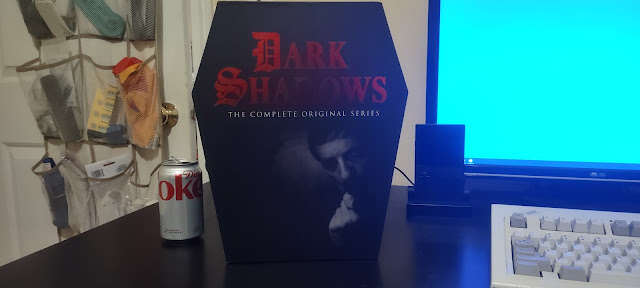
Dark Shadows - The Complete Original Series Review


Dark Shadows is a landmark of classic television, introducing the concept of a supernatural, gothic horror soap opera to daytime television.  The series ran for 1,225 22-minute episodes from 1966-1971.  While I could wax on all day about the history of Dark Shadows and its significance, and have in the past, there are other sites on the internet which can do that in a more knowledgeable manner.  Today I am hear to talk about the epitome of Dark Shadows, the Complete Original Series boxset (DS:COS) and offer my review of it.  

Monday, November 29, 2021

Reconstructing a "Lost" Version of The Phantom of the Opera in HD

I sometimes like to think of fan-based restorations of classic films, whether they are of a Godzilla film, a Walt Disney classic short or Star Wars, as the culmination of film restoration.  The Internet and broadband has fueled talented creators to take films from whatever sources they can find and make something even better than the studios which made or have rights to these films did or could.  I have talked about this subject before and in the recent past I have done a few minor projects myself.  Unfortunately due to the nature of the films such projects often cannot be shared publicly.  My most recent project is safe enough to share and touches upon a subject I have discussed in the past, the 1925 version of The Phantom of the Opera.  Specifically my goal was recreate the first version of Phantom I ever saw, the Killiam Film Classic release.  Sit back and let's go over why this release was significant, how it entered my notice and how I restored it to what I hope will be seen as its "proper glory."

Tuesday, December 24, 2019

A Brief History of Godzilla on Home Media

Before home video tape and disc formats was available, the only way to see a motion picture was in the theater during its first run or through a reissue.  Later, when television became available films would be available for broadcast but TVs were expensive in the 1950s, color TV was expensive until the mid 1960s, and studios typically did not make their prestigious library titles available at first (with occasional exceptions) because they still viewed themselves in competition with television.

Godzilla movies have been released on home video for a very long time, longer than many people may realize.  With the release of the Criterion Showa set on Blu-ray, we will finally have had a release of every Godzilla film on HD disc.  Here in this blog article I will give a brief overview of the franchise's release history on all home video formats, both popular and obscure.  I am concentrating on what was available in the English-language market, with which is what I am the most familiar.

Sunday, May 19, 2019

Quatermass and the Pit Blu-ray Review


The serial format, breaking down a story over multiple, distinct parts, has a very long history.  Silent film serials were followed by sound film serials, and up and until the 1950s the genre had fulfilled a need for audiences to be entertained in a weekly format.  Television's introduction led to the downfall of serials from Republic Films and other studios that specialized in narratives punctuated by cliffhangers.  The format did not generally translate well to television, where people expected a program to begin and end in one viewing.  In the 1950s there was no real ability for an average TV viewer to record programming to watch at a later time, you either saw the program or you hoped for a repeat.  This suited television broadcasters, who wanted viewers to experience a new story every week.


That was the evolution in the U.S., but the U.K. was not yet ready to abandon the classic serial format.  The British Broadcasting Corporation, a publicly-funded TV network, had to fill the same number of hours in a day but with fewer resources that its American commercial televison network counterparts.  The serial format had its advantages in cost, sets, costumes, production personnel and actors could be reused for several weeks at a cost significantly less than having to mount brand-new productions every week.  Serials were broadcast alongside series not only by the BBC but also the ITV affiliates for a solid three-decade period.  Here I am going to offer my thoughts on one of the best of the serials ever produced from this period, Quatermass and the Pit as presented in its November 2018 Blu-ray release. 


Tuesday, December 25, 2018

Nonsense and Other Observations about Dracula/Horror of Dracula

As much as I love Dracula (1958)/Horror of Dracula, I find it has a lot of plot holes, ideas that don't make a lot of sense and other weirdness.  I started to write down certain observations as I was watching the film and eventually they became so long that I thought them worth putting them up in a blog post.  These observations as I have put them to type have been as timestamped to the times (roughly) in the film to which they most apply.  I am using the 2012 Hammer Restoration found on the 2013 Region B/2 Blu-ray/DVD from Lionsgate with altered color timing by a fan (which eliminates the overly-blue tint found on that disc).  Any DVD or Blu-ray release should be able to follow along without too much difficulty.

Sunday, August 13, 2017

The Mandela Effect - The Nerdly Version

There exists a phenomenon called false memory.  These are memories which a person sincerely believes are true yet can objectively be shown to be false.  A colloquial name for this is the "Mandela effect", so named because many people in the late 1980s and into the 1990s believed that Nelson Mandela was dead.  Given that he was imprisoned by the South African government from 1962 to 1990, people could be forgiven in the pre-Internet days that he was dead.  In the context of suppressed memory cases, usually involving child sexual abuse, the theory is very controversial.  However, I am not going down that road.

Instead I am going to pull some false memories from elements of popular culture which I have found interesting.  James Rolfe did an excellent video in his Angry Video Game Nerd series satirizing the supposed "Berenstain Bears Conspiracy" : https://www.youtube.com/watch?v=LB3CybXl8rs  The conspiracy alleges that there has been a concerted effort to change the authorship of the Berenstain Bears books from "Berenstein" to "Berenstain."  After all, doesn't everybody remember the "Berenstein Bears"?  I remember the books and the shows being referred to as the "Berenstein Bears" and used that label to refer to them myself.  I would suggest that the mistakes lies in three factors.  First, "Berenstein" and "Berenstain" are very similar words.  Second, "Berenstein" is a more common surname than "Berenstain"  Third and perhaps most important, "Berenstein" is easier to say that "Berenstain."

So from my own experiences, let me describe two instances where I probably am the subject of false memories.  Originally I was going to describe three memories, but I forgot what the third memory was!  [Update : I finally recalled what it was!]  For the three examples I will explain the origins of the memory and try to explain how I may have acquired the memory falsely.


Thursday, March 30, 2017

Giving the Studios the Bird : Fan Reconstructions of their Preferred Versions of Classic Films

In the past several years, there has been an increasing proliferation of the fan re-edit and the fan reconstruction of classic films.  One of the chief reasons for this was the Star Wars Special Editions.  But fan reconstructions have gone far beyond a Galaxy Far, Far Away.  Read on to discover another community increasingly devoted to reconstruction.  But before we get there, let us set the stage during the long winter of our discontent :

The Story Behind the Star Wars Special Editions and Despecialized Editions

Back in 1997, fourteen years after Return of the Jedi, George Lucas decided to reedit the original trilogy to reflect how he believed the films should be presented and enjoyed given the advances in technology between 1977, 1980, 1983 and 1997.  At first, these Special Editions (SEs) were met with some interest and were released on VHS and Laserdisc.  Given that the untouched versions (now known as George's Original Untouched Trilogy or GOUT) of these films were also available at that time on VHS and Laserdisc and the Internet was just becoming a part of everyday life, complaints were fairly muted at the time.


Sunday, March 12, 2017

First World Problems : Finding a Good Movie Theater Screen

Here is a problem : You live in an area where there are a almost a dozen movie theaters showing first run films within a 25-mile radius of your house but you are almost an hour away away from a major city.  You want to see a large budget, action and spectacle heavy film.  This means you want to see it on a big screen with a powerful sound system.  The same screen may not be necessary for an intimate drama or a raunchy comedy, but when it comes to action, bigger is usually better.

The biggest films, especially action/adventure films, tend to be shown on more than one screen, at least on opening weekend.  Today, many of the big films are converted to 3-D, even though most were not shot with 3-D in mind.  In the theaters around me, there will be separate screens devoted to the 2-D version and the 3-D version.  A couple of theaters near me have a giant screen.  Showcase Cinemas and AMC refers to their giant screen as IMAX (licensing the trademark) and Regal Cinemas calls their screen RPX.  These will always show the 3-D version of the film.  In the upcoming years, there may be a battle between the two chains and their competing 4D technologies, (Showcase uses MX4D, Regal uses 4DX) but that is the subject of another blog entry.

I saw Kong : Skull Island on the local-ish Showcase Cinema's IMAX screen.  Some commentators have derisively called these screens "LIEMAX" because they are smaller than a true IMAX screen.  While there are dedicated IMAX theaters in my state with the enormous screen, they are much further away than the local IMAX.

The local IMAX gives a very good presentation compared to non-IMAX sized-screens.  I saw Star Wars Rogue One in the 2-D version at the Regal Cinemas theater and was very disappointed with the size of the screen.  Not only was it small, it was noticeably offset from the center of the room.  I have a suspicion that these shoebox theaters may only be using 2K projectors, the industry standard is to use 4K projectors.  The movie deserved better.

The problem is these cinema chains only show the 3-D version of the films.  If you want to see a 2-D version of the film, you are often left with small screens and small theaters that just don't do the action on-screen justice in this day and age.  While the 3-D conversion of Kong was without major flaws, the glasses I had to wear were uncomfortable and tended to fog up around the bridge of the nose.   You simply cannot take off the glasses and expect to enjoy what is on the screen, it will appear blurry thanks to the dual projection of the 3-D images.

I find that 3-D does not particularly add much to a film that was not shot with 3-D in mind.  On the other hand, when the film was shot with 3-D in mind and projected on a huge screen, as was the case with Gravity, the experience is incredible.  Moreover, a 3-D conversion does not reflect the director's intent unless the director supervised the process. There are also 4D conversions of films that add moving seats and other tactile sensory perceptions, but that kind of gimmickry only reflects the studio's intent, not the director's.

While I am on the subject, Showcase Cinemas has a dizzying array of theater options.  Depending on the theater, you could have choices of a 2-D screen, a 3-D screen, a Lux Level option for each ( with food service), an IMAX 3-D screen, an MX4D screen (motion seats and sensory effects) or an XPLUS screen (featuring Dolby Atmos sound).  There are also a few SuperLux theaters that seem more focused on comfort and food than a pure or traditional moviegoing experience.  Offering a comprehensive experience with a restaurant, bar, comfy seating and in-movie service does seem to be the trend in upscale movie theaters.

Friday, February 10, 2017

Unusual Film Formats on Blu-ray

Blu-ray disc may not have been as successful as DVDs, but its capabilities have allowed it to embrace and do some justice to unusual film formats.  Let's discuss some of them.  For screenshots, I will refer the reader to the Blu-ray.com article with the appropriate links (when available), which has excellent, multiple full-HD screenshots for most of the films I will be discussing here.  All Blu-ray covers are taken from Amazon.com or Amazon.co.uk with one exception noted below.


Thursday, November 3, 2016

Godzilla - International Obsession

When Toho first began offering their Godzilla films for release for U.S. markets, it would supply a  copy of a Japanese print.  The U.S. distributor would then make whatever edits and additions it deemed appropriate, dub the film into English and release it.  Typically the print would be sent to the U.S distributor without text credits, leaving the inclusion of credits to the local distributor.  

However, by the mid 1960s Godzilla and other Toho films were increasingly offered in two versions, a textless version suitable for alteration and an International version which could be put into theaters or on TV immediately.  International versions could be sold to other English-speaking countries or non-English speaking countries where it would be easier to dub the film into the local language by translating English instead of Japanese.

An International version of a Godzilla film is characterized by several features.  First, the Japanese credits are translated into English.  The typeface used will invariably be white.  Second, the film will be distributed uncut from its Japanese version.  Third, the film will be dubbed into English in Tokyo (until 1972) or Hong Kong (1972-2004).  International versions were deemed appropriate for the TV and home video markets, but more quality-conscious distributors like American International Pictures, New World Pictures and Sony Pictures decided to commission new dubs for the films they released theatrically.