Neverwinter Nights was released by SSI and America Online in March, 1991 and discontinued on July 19, 1997. This game was an adaptation of SSI's Gold Box engine to support online multiplayer. The Advanced Dungeons and Dragons 1st Edition ruleset were used as a basis for the engine. It is notable as the first graphical massively multiplayer online role playing game. The engine on which it was built was designed for a single player, so how did it work as a multiplayer game? This blog will attempt to answer that question and give all the information about how the game ran over time which is still available.
Thursday, March 12, 2026
Saturday, November 8, 2025
USPS Media Mail Rules are Arbitrary and Stupid
The United States Postal Service offers a shipping option called Media Mail. Media Mail is a popular way to ship certain types of goods through the mail because it is cheap and offers a tracking number. It is not the fasted form of shipping but many buyers are prepared to wait an extra day or two or three for their package to be delivered. Media Mail allows printed material, books, periodicals, literature, plays, audio and video recordings to be shipped at a reduced rate compared to Priority Mail. But it does not allow all things which might fall into these categories or like categories. The rules are riddled with contradictions and outdated approaches. We will look at two such applications, comic books and video games.
Sunday, September 28, 2025
Nintendo Gives you the Power of Flash - Nintendo Power Rewritable Cartridges
![]() |
| Courtesy of Wikipedia, Photo by Muband |
Three times Nintendo released a product where you could write new games to existing media. The first was the Famicom Disk System, where users could bring in their disks to Disk Writer kiosks in stores and have new games rewritten to the floppy disks. This system began in 1986 and was modestly successful, newly written games were cheaper than buying either new cartridges or new disk games in boxes. The disk system's popularity waned by the 1990s, but Nintendo revived the concept with the Super Famicom Nintendo Power cartridge in 1997. A few years later they released the Game Boy Nintendo Power cartridge in 2000. They discontinued the service on February 28, 2007. In this article I will discuss how the service worked, how the flash cartridges worked, and how they can be flashed today.
Tuesday, June 24, 2025
The Famicom Top 100 List, Brought to you by Famitsu
![]() |
| Number 100: Gradius II - Number 1: Dragon Quest III |
To commemorate the Famicom's 20th anniversary, Famitsu released a special DVD celebrating the console and its games. The main feature on the disc is a top 100 countdown, listing the most popular Famicom games. The list is a fascinating look into the tastes of the Famicom's original audience and the only one of its kind. Let's break it down today.
Friday, December 13, 2024
Game Boy Tetris New vs. Old - ModRetro Chromatic Tetris
The company ModRetro has released their Chromatic, an FPGA handheld console which simulates a Game Boy Color and plays Game Boy and Game Boy Color games. It retails for $199, which may seem rather pricey but to attract buyers ModRetro developed a new version of Tetris and bundled it with the console. This version of Tetris can only be purchased with a Chromatic, it is not available separately. Having bought a Chromatic I intended to review both the console and its game, however as the console review was already pretty long and the game review ended up being lengthy in its own right, I decided to split the article into two parts for easier reading. In this article I will review the Tetris games which came before ModRetro's, give an overview of ModRetro's features and gameplay and see how it stacks up against its predecessors and whether it offers good value to the Chromatic package.
Wednesday, February 14, 2024
Nintendo's Console Accessory Cheapness
Nintendo's consoles have, for the most part, been somewhat high priced over the years. The company likes to keep it that way, you will not see a Nintendo console in a bargain bin or heavily discounted, even toward the end of its lifespan. The maintenance of price contributes to its "prestige branding." Nintendo usually makes a modest profit on the consoles it sells, unlike Sony and Microsoft it does not solely rely on software sales to make up the cost of hardware production. But those profits come at a price for the consumer, especially in Japan. Let's see how Nintendo cut costs when releasing consoles in its native country.
Wednesday, January 17, 2024
King's Quest IV - The First True PC Compatible Game
![]() |
| KQ4 Box, courtesy of MobyGames |
When we think of PC Compatible games, thoughts of freedom may pop into one's mind. Intel, nVidia, AMD, gamers generally have a choice of which hardware to use in their systems. PC games have been, generally speaking, not tied to any particular manufacturer's hardware. Competition within the PC hardware market allowed consumers the luxury of choice. In the 1990s and onwards your motherboard could have been made by one manufacturer, your graphics card by another and so on and you could get a really good gaming experience. But this was not always the case, PC compatible games of the 1980s were often seen as lacking compared to other computers and generic PCs were content to clone rather than innovate. This all began to change in 1988 when King's Quest IV was released. In this blog article I will briefly summarize the evolution of PC gaming hardware and then discuss how KQ4 opened up PC gaming into what would eventually become the default non-console paradigm of how to play video games.
Monday, November 20, 2023
Dai Yakyuu! - The 8-bit Explosion of Japanese Baseball Video Games
![]() |
| Baseball & Famista '94 |
Baseball (Yakyuu) has had a long history in Japan. Imported from the United States before World War II, Japan built leagues and fielded players that have maintained the popularity of the sport more or less ever since. When video games became accessible to the Japanese in the late 1970s, they tried to mimic a wide range of human competitive activities, not unlike American consoles. Judging by the Famicom's game library, baseball would have been the most popular sport played in Japan by far. Dozens of baseball games were released during the decade of the Famicom's active commercial development, let's take a look at some games and some trends in these titles.
Wednesday, June 28, 2023
Rethinking the Video Game Generations and Handheld Video Games
Generations of video games have been defined in reference to home video game consoles which were released over time and their capabilities. While I have some views on that subject, in today's blog I wish to talk about generations of handheld video games. Handheld video games have always lagged behind their home console brethren due to their need to work within smaller sizes and smaller power sources. In this blog video I will trace the hardware developments in the handheld world and categorize them into eras and technologies which make sense.
Sunday, August 21, 2022
Media and Console Longevity - Lengthy Support for Cartridges and Discs from Certain Consoles
Some consoles, even some of the most popular ones, can only have their games played on those consoles within that "family" of consoles. Other games, through backwards compatibility, can be played on a more advanced family of consoles. Some game had hardware made to play them for an exceptionally long period of time. Today we will explore some of the console systems whose games' medial were given an exceptionally long (about 10 years) official lifespan.
Sunday, August 7, 2022
Sears (Atari) Tele-games Pong vs Magavox Odyssey 100 - Battle of the First Pong Consoles
Debuting in the fall of 1975, the Sears release of Atari's home version of Pong was a big success for that holiday season. Owning a first-generation video game console like Atari Pong had been something of a dream of mine for quite a while. The importance of Atari's first Home Pong console cannot be understated and much has been written about it. I recently acquired a Sears Telegames Pong and wanted to talk about the machine and its significance in this blog article. I also obtained a competitor to Sears/Atari's Pong, the Magnavox Odyssey 100, and wish to compare the two here.
Monday, June 20, 2022
The Successors: Evolution of Monochrome Handhelds after the Game Boy
When the Nintendo Game Boy was released in April/July, 1989 (Japan/North America), there was nothing like it on the market. The Game Boy was the first programmable handheld system with sufficient capabilities to play games that were similar to the home consoles of its day. The Game Boy was intended to be an inexpensive device, so it used a monochrome reflective green screen rather than a difficult-to-manufacture and power hungry backlit color screen like its main competitors, the Atari Lynx, Sega Game Gear, NEC Turbo Express and later the Sega Nomad. Although the Game Boy definitively ruled over the color competing systems, dominating the market until its successor, the Game Boy Color, was released in October/November of 1998, that does not mean it was the only monochrome handheld game console on the market. Early in its lifetime it had competitors from Taiwan which tried to take away some of its market with little success. Later, more established companies tried to get on the monochrome bandwagon, only to find that lightning does not necessarily strike twice. Recently, as retro style gameplay experiences have found a market in the age of the Nintendo Switch, we have seen at least one or two companies try their hand at a monochrome handheld. In this article we will trace the evolution of the consoles that tried to compete with the Game Boy or invoke its success.
Wednesday, March 16, 2022
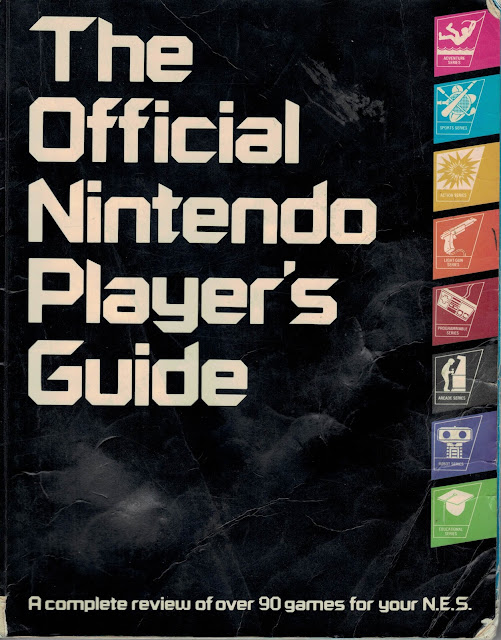
The Official Nintendo Player's Guide - Review of the First US-Based NES Game Guide
When the NES was just starting out in 1985 and 1986, there really was not a whole lot of information available about the games for the system other than TV and magazine ads and the manuals, advertisements and posters included with the games. At the beginning of 1987, Nintendo began publishing a subscription newsletter called the Nintendo Fun Club. Priced at $2.50 an issue and continually improving for its seven issues before Nintendo expanded the magazine to become Nintendo Power, it was one way by which Nintendo could connect with its ever-growing audience of fans and game players. The magazine began by offering tips and previews for the latest games, but the early issues were fairly limited in their ability to provide a comprehensive look into more than one game per issue. So Nintendo advertised a special book in its later issues of the Fun Club, The Official Nintendo Player's Guide, copyright 1987. In this blog post I will take a look at it and its significance to Nintendo's history.
Sunday, December 19, 2021
Nintendo Board and Chip Manufacture and Third Parties
I have often read that Nintendo, as of the Nintendo Entertainment System and everything thereafter, made all cartridges for its systems and required third parties to buy chips, board and other raw materials from them in order to have their software run on Nintendo's systems. While this was often true, the rule was not an absolute one and at times exceptions were made.
Nintendo does not make anything, it does not construct silicon wafers, it does not extrude plastic into molds, it does not own factories or fabrication plants which do these things. Nintendo designs and patents chips and products, but turning those designs into reality is a function of contractors. Obviously Nintendo has to work closely with those contractors to ensure its designs can translate into workable devices, but it is not correct to say that Nintendo really "made cartridges". In this article we will look at instances where Nintendo permitted third party cartridges to be made.
Wednesday, September 1, 2021
Nintendo, Sega and the World Outside Japan and North America - Accommodating Non-English Speakers
Sunday, March 28, 2021
Family BASIC - Putting the "Computer" into the Family Computer
![]() |
| Courtesy of Wikipedia (taken by Evan Amos) |
When Nintendo released its first console, the Famicom, the full name of the system was the Nintendo Family Computer. In the early 1980s the line between video game consoles and home computers was a fuzzy one. Some consoles, like the Odyssey^2 had a full (membrane) keyboard but were more like video game consoles. Some computers like the Commodore 64 had a full-travel keyboard and a disk drive but could also play games via its Expansion Port. At the Famicom's launch in 1983, the only software available for the machine were arcade game ports. By the next year (1984) Nintendo had released a new product for the Family Computer which was intended to do more than just play another video game. This product was released as Family BASIC on July 21, 1984, but was only released in Japan. Did it succeed in turning the Famicom into a Family Computer?
Saturday, April 4, 2020
The Taiwanese Connection - The Source for Many Unlicensed NES/Famicom Games
![]() |
| Joy Van - Twin Eagle |
![]() |
| AVE - Double Strike |
Taiwan was called one of the four Asian Tigers (with Singapore, South Korea and Hong Kong), small countries which had developed economically very rapidly after from the 1960s to the present to compete with much larger countries. Taiwan embraced technology, creating chip fabrication plants and becoming indispensable to the PC revolution. Video game consoles were hardly overlooked by the island, and Nintendo was the largest publisher of console video games in Asia. There was no protection system in place for the Nintendo Famicom, so Taiwan programming firms began developing unlicensed games for that console around 1986.
At the same time, Nintendo was becoming the largest publisher of video games in North America thanks to the success of the NES. Third parties were naturally attracted to the increasingly successful system, but Nintendo was a hard business partner. Nintendo required companies to buy cartridges manufactured by Nintendo, required cartridge orders in large unit quantities, limited the number of cartridges a company could release in a year and scrutinized the content of the games to be published. After Tengen showed that it was possible to develop and release cartridges without Nintendo's sanction, other companies like AVE and Color Dreams entered the market as unlicensed publishers. But they needed games to sell and the number of programmers who could handle Nintendo's console were limited, so sometimes they turned to Taiwan.
Monday, October 28, 2019
Nintendo's 8-bit Obsession with Golf
Tuesday, July 18, 2017
Early Video Game Content Advisories - Who Needs Ratings Systems?
Saturday, April 22, 2017
The Evolution of King's Quest (I AGI)
IBM bankrolled much of King's Quest's development, but the game would not be available at launch.
However, by the time King's Quest was released in May of 1984, the market had shown that it was not about to become IBM's playground. The PCjr. was overpriced cost twice as much as the Commodore 64 with a disk drive and did not offer much to the consumer that the C64 could not. The Apple IIe and //c computers were also strong competitors at the same price, offering a huge library of software. The PCjr struggled with compatibility with several popular IBM PC programs and included a keyboard that was laughable for trying to get real work done with it.