The original Commodore 64 had a pretty long run for a computing platform, released in 1982 and discontinued in 1994. Its fortunes mirrored that of the company which developed it as Commodore achieved its greatest success with the C64 and never quite managed to achieve a similar level of market dominance thereafter. Now there is a new Commodore 64, the Commodore C64 Ultimate, which promises to be an end-all, be-all solution to running C64 software on a platform worthy of the Commodore legacy. Today, having had a chance to play with one for about a week, I can put those claims to the test.
Saturday, March 14, 2026
Saturday, August 26, 2023
Would you Like a Book 8088? Or How About a Hand 386?
Fairly recently (May, 2023) there has been made available for sale a retro-themed laptop called the Book 8088. The Book 8088 is a real PC running a fair amount of vintage hardware and was made in China by a company called DZT. Additionally this company has also made a portable PC called the Hand 386. However, the Book 8088 is also the subject of controversy and reviews have been mixed on both products. Although I do not own either and have no intention to buy either I have researched and viewed enough YouTube reviews of the device to offer some relevant insights on these devices.
Thursday, July 20, 2023
Apple IIc - Epitome of the Apple II Experience?
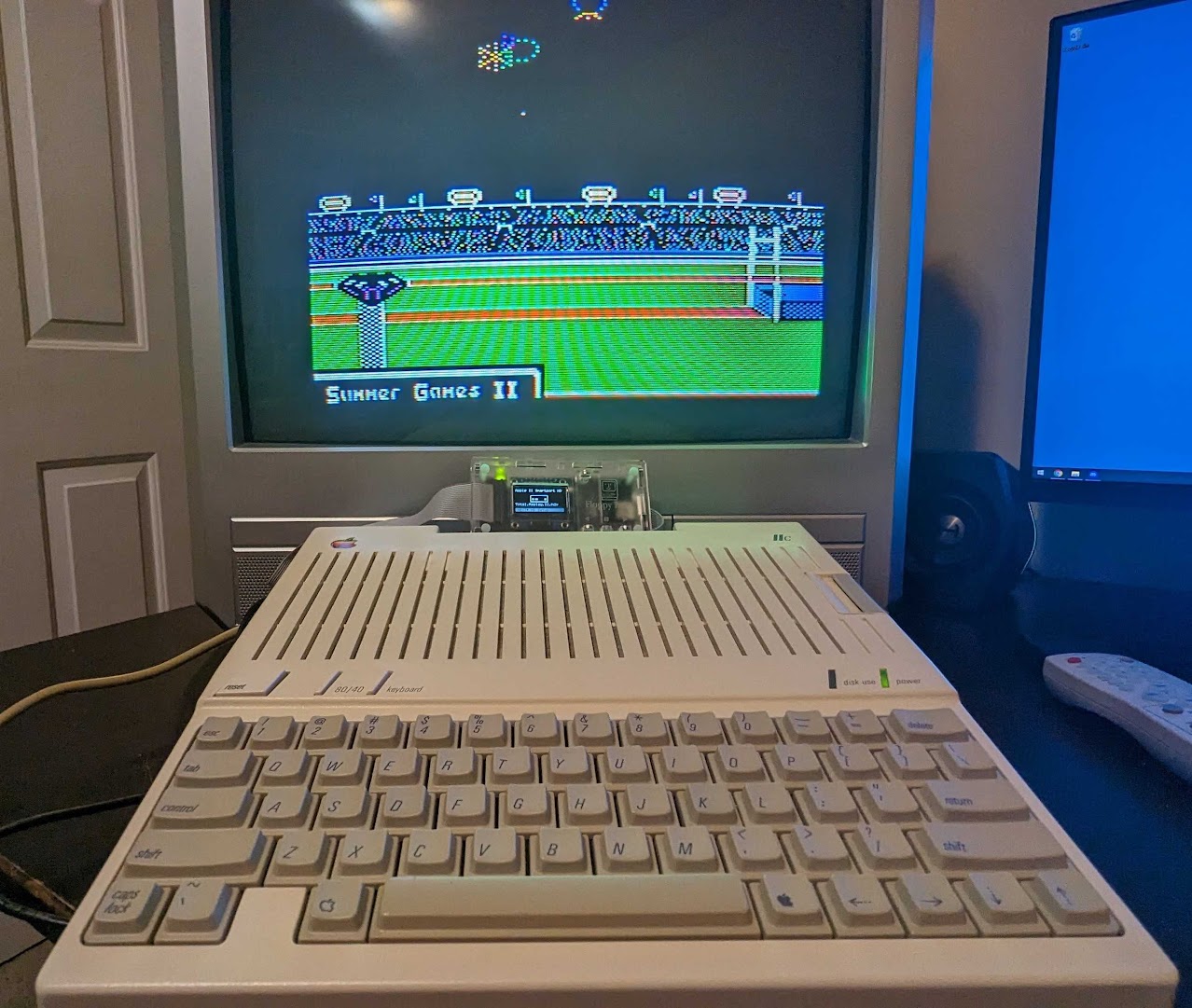
In 1984 Apple Computer released the fourth computer to its Apple II line, the Apple IIc, A2M4000. The Apple IIc was a "compact" version of the Apple IIe with many expansions built-in. It was released alongside the Macintosh and despite the hype the market did not respond in the way Apple had hoped. Nonetheless they still sold about 400,000 systems from 1984-1988. In 2023 these systems can still be purchased for $150-200, so let's take a look to see what makes them special.
Saturday, June 17, 2023
The Kneale Watcher, Reader & Listener
Nigel Kneale (1922-2006) was a British/Manx author whose influence on science fiction, supernatural fiction and television drama cannot be understated. Kneale wrote many scripts, screenplays and stories that would have a formative influence in English drama. While Kneale is best known for his Quatermass stories, his work is much more varied than those relating to Professor Bernard Quatermass. He has a fairly vast body of work that still exists, although due to the nearsighted preservation practices of the BBC and ITV affiliates of the 1940s-1970s, many of his contributions to TV drama do not survive, at least in their original form. The man wrote books, TV plays, film scripts and radio dramas. The purpose of this article is to identify what of his "genre work" still exists, what has been released and the best versions available to acquire. While books have been written about Kneale's career, impact on modern genre fantasy and his works, here we will let the author speak for himself directly to his audience.
Friday, August 12, 2022
Turn your DVD Player onn. - A Review of the $25 Wal-mart Wonder
DVD and DVD players were once considered necessities for gracious living. The technology has been around for over 25 years now and remains the lowest common denominator of delivering film and television in a permanent (non-streaming) form to the masses. Although the venerable disc format has been eclipsed by Blu-ray and more recently 4K Ultra HD Blu-ray, some of us still find value in our DVD libraries, especially for those discs which have content unique to them or can only be put on a Blu-ray as an upscale. And sometimes you need just a DVD player. Wal-mart has a house brand called onn. which manufactures an inexpensive DVD player. Last year I found I needed a DVD player to play discs on my CRT, having rediscovered the benefits of watching certain discs on a CRT, and saw that the onn. DVD Player was only $25 and decided to take a chance on it. In this blog entry, I will relate how I discovered some rather pleasant surprises with this player with you.
Monday, August 1, 2022
The Godzilla Series Japanese Film U.S. Theatrical Releases
Godzilla was first introduced to the wider world through the medium of the cinema. Western theater audiences were exposed to Godzilla and other Japanese sci-fi films on a fairly regular basis during the 1950s, 1960s and 1970s. Godzilla's theatrical releases have garnered particular attention, the series is still going after almost seventy years. A theatrical release of a foreign film in the US is a particular mark of distinction and prestige, and many people believe it is important to try and preserve these films as close to the way they were exhibited as possible. The Godzilla franchise is one of the most successful in history but during its films theatrical runs would the greatest number of people see the film at one time.
Some of Godzilla's theatrical releases are well-known and readily available, but most have fallen into obscurity. Even in the VHS era when theatrical releases were more available, there was usually something missing or altered such as credits and title screens. In this blog article I will identify what you would have seen in terms of credits and titles if you saw these films in a US theater during their wide release theatrical runs.
Monday, November 29, 2021
Reconstructing a "Lost" Version of The Phantom of the Opera in HD
I sometimes like to think of fan-based restorations of classic films, whether they are of a Godzilla film, a Walt Disney classic short or Star Wars, as the culmination of film restoration. The Internet and broadband has fueled talented creators to take films from whatever sources they can find and make something even better than the studios which made or have rights to these films did or could. I have talked about this subject before and in the recent past I have done a few minor projects myself. Unfortunately due to the nature of the films such projects often cannot be shared publicly. My most recent project is safe enough to share and touches upon a subject I have discussed in the past, the 1925 version of The Phantom of the Opera. Specifically my goal was recreate the first version of Phantom I ever saw, the Killiam Film Classic release. Sit back and let's go over why this release was significant, how it entered my notice and how I restored it to what I hope will be seen as its "proper glory."
Friday, July 16, 2021
Keeping the Upscale and Capture Pure - The RGBtoHDMI and Digital PC Video Standards
When IBM was designing video display adapters for its IBM PC, it treated video quality as important. While the world of displays was in 1980 essentially analog, IBM chose to use digital outputs for its IBM Monochrome Display and Printer Adapter and Color Graphics Adapter. Later it continued to use a digital TTL interface for the IBM PCjr.'s built in video and its Enhanced Graphics Adapters. Competitors and copycats, like the Hercules Graphics Card and the Tandy 1000's built-in video, also copied IBM's usage of the DE-9 port carrying digital color signals. While some of the color cards had composite color video support, serious business usage demanded the use of a monitor which could accept those digital signals for the highest possible picture quality possible.
By 1987, the limitations of the digital interface, with each color primary requiring a separate collection of wires, was too limiting for IBM's Video Graphics Array. The connector was changed and the colors were output over an analog interface, which only required one pin per color primary. The VGA analog video standard remained the principal way by which PCs connected their displays for over fifteen years. By the time the digital DVI connector became popular enough to replace VGA, the older pre-VGA standards had been long consigned to the realm of retro-computing.
Today the modern display device tends to eschew any display standard older than DVI, with most only having HDMI and DisplayPort inputs. The digital standards of old used special CRTs, which have become expensive and often require repair or restoration due to age. Those of us who enjoy working on retro computers are faced with having to "settle" for composite video, having to fork out large amounts of money and space for the special digital CRTs displays or use rather particular capture cards to see what was intended. The RGBtoHDMI is one really good solution for these issues, let's take a look at it.
Friday, May 7, 2021
RetroUSB AVS : The Affordable NES FPGA Console
![]() |
| RetroUSB AVS, courtesy of RetroUSB.com |
The NES is undoubtedly the most cloned video game system ever, and in the 2010s FPGA technology had decreased in price to the point where it was affordable to implement retro video game systems on an FPGA. The RetroUSB AVS was the first NES FPGA console made available to the public, and while I have discussed it before on this blog, I have not done a full review of the AVS because I never had one in my possession before. That changed recently thanks to a friend of mine who let me borrow his for testing and review. As this console is almost five years old at this point and is the only NES FPGA console you can currently pre-order, I think it is time to see where it has progressed and how well it has held up over the years compared to more recent competition.
Saturday, March 28, 2020
MiSTer - The MAME of FPGA Simulation Projects
![]() |
| MiSTer Fully Assembled (courtesy of MiSTer Github Wiki) |
An FPGA console is a modestly priced solution to lag. FPGAs simulate original hardware at the logic level and can simulate multiple processes in parallel. A software emulator must recreate a system alien to the hardware on which it is running and is essentially limited to processing multiple hardware events serially. The most popular FPGA solution not made by Analogue is based on the DE-10 Nano FPGA development board. This board is the key to the MiSTer project, a group of cores which simulate various video game consoles, computer systems and certain arcade machines under a common framework. In this blog entry (or entries), I will dive into the world of MiSTer and discuss the aspects I like and dislike.
Tuesday, December 24, 2019
A Brief History of Godzilla on Home Media
Godzilla movies have been released on home video for a very long time, longer than many people may realize. With the release of the Criterion Showa set on Blu-ray, we will finally have had a release of every Godzilla film on HD disc. Here in this blog article I will give a brief overview of the franchise's release history on all home video formats, both popular and obscure. I am concentrating on what was available in the English-language market, with which is what I am the most familiar.
Tuesday, October 29, 2019
Game Boy Interface Revisited
Sunday, May 19, 2019
Quatermass and the Pit Blu-ray Review
The serial format, breaking down a story over multiple, distinct parts, has a very long history. Silent film serials were followed by sound film serials, and up and until the 1950s the genre had fulfilled a need for audiences to be entertained in a weekly format. Television's introduction led to the downfall of serials from Republic Films and other studios that specialized in narratives punctuated by cliffhangers. The format did not generally translate well to television, where people expected a program to begin and end in one viewing. In the 1950s there was no real ability for an average TV viewer to record programming to watch at a later time, you either saw the program or you hoped for a repeat. This suited television broadcasters, who wanted viewers to experience a new story every week.
That was the evolution in the U.S., but the U.K. was not yet ready to abandon the classic serial format. The British Broadcasting Corporation, a publicly-funded TV network, had to fill the same number of hours in a day but with fewer resources that its American commercial televison network counterparts. The serial format had its advantages in cost, sets, costumes, production personnel and actors could be reused for several weeks at a cost significantly less than having to mount brand-new productions every week. Serials were broadcast alongside series not only by the BBC but also the ITV affiliates for a solid three-decade period. Here I am going to offer my thoughts on one of the best of the serials ever produced from this period, Quatermass and the Pit as presented in its November 2018 Blu-ray release.
Monday, April 15, 2019
Three High-Quality 1080p Game Boy "Consolizing" Solutions Compared
Wednesday, February 6, 2019
Proper Analog Retro Video Capture with the Datapath E1/E1s
Tuesday, December 25, 2018
Nonsense and Other Observations about Dracula/Horror of Dracula
Saturday, June 23, 2018
New Accessories and Ideas for the Game Boy Camera
![]() |
| Courtesy of Wikipedia |
Sunday, March 18, 2018
Compatibility Issues within the Game Boy Line
Sunday, February 4, 2018
StarTech USB3HDCAP Review - A Jack of All Trades?
![]() |
| The StarTech USB3HDCAP (courtesy of Amazon.com) |