When Gary Gygax was transforming Original Dungeons and Dragons into Advanced Dungeons and Dragons, one of the core components of the rules he focused on were the combat rules. Combat was rather sketchily defined in OD&D, and that is being kind. His priorities for the Advanced system were that combat was to have a sufficient rule structure so that one game of AD&D would play more or less the same as the next. This was at a time when campaigns often had 35th level fighters and 26th level balrogs in the same party! But perhaps Gygax was a little too overzealous in laying down rule after rule to govern every conceivable aspect of combat he had encountered to that time. In this blog article we will explore some of the more obtuse rules and see how they worked in print, what may have happened in practice and how the 2nd Edition of the Rules tried to address issues with the 1st Edition.

Sunday, March 20, 2022


Wednesday, March 16, 2022
The Official Nintendo Player's Guide - Review of the First US-Based NES Game Guide
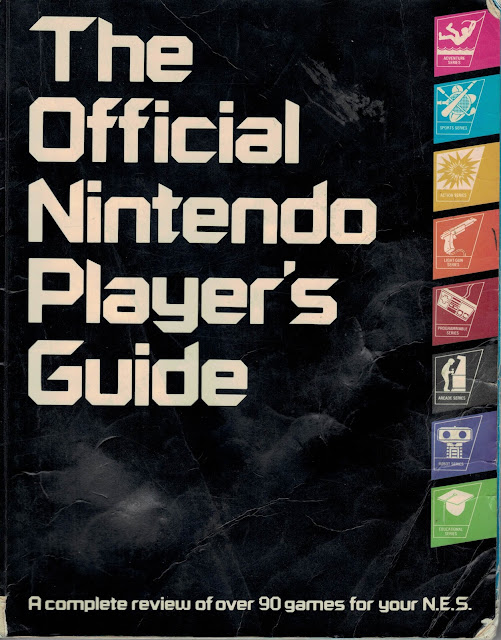
When the NES was just starting out in 1985 and 1986, there really was not a whole lot of information available about the games for the system other than TV and magazine ads and the manuals, advertisements and posters included with the games. At the beginning of 1987, Nintendo began publishing a subscription newsletter called the Nintendo Fun Club. Priced at $2.50 an issue and continually improving for its seven issues before Nintendo expanded the magazine to become Nintendo Power, it was one way by which Nintendo could connect with its ever-growing audience of fans and game players. The magazine began by offering tips and previews for the latest games, but the early issues were fairly limited in their ability to provide a comprehensive look into more than one game per issue. So Nintendo advertised a special book in its later issues of the Fun Club, The Official Nintendo Player's Guide, copyright 1987. In this blog post I will take a look at it and its significance to Nintendo's history.
Saturday, February 26, 2022
Removed or Changed References to J.R.R. Tolkien and His Works in D&D
When Dungeons and Dragons was first released, it made no secret of its many literary influences. Authors which helped inspire the game included Robert E. Howard, Clark Ashton Smith, Fritz Leiber, Jack Vance. One author which stood above all others in the fantasy writer canon was J.R.R. Tolkien, whose work, The Lord of the Rings, had a popularity unmatched by any other fantasy author at that time and arguably since.
Even though Gary Gygax, the author of Chainmail (1971) and co-author of Dungeons and Dragons (1974), was not the greatest fan of Tolkien's work, he had no compunction about including certain of Tolkien's creations in his published work. The most notable was the inclusion of Hobbits as playable troop types characters whose characteristics were described in the above-mentioned works. Other Tolkien creations, like Balrogs and Ents, also featured in the games. Their inclusion continued in the five D&D Supplements and the D&D Basic Set published from 1975 to 1977.
While D&D was a small niche hobby publication, this unapproved borrowing did not attract notice, but as the popularity of D&D increased it started receiving mainstream attention. Sometime in mid-to-late 1977 TSR, the publishers of D&D, received a letter from representatives of Tolkien Enterprises (which held the film rights) demanding they cease using Tolkien's literary creations in their products. TSR then complied with the demand by trying to rename every instance of a Tolkien-derived name from their products and reprinting them. But some references were thought too blatant to just handle with a name change, so the balrog and several references to Tolkien got cut from the texts. This blog entry will try to identify every change in these works.
Tuesday, February 8, 2022
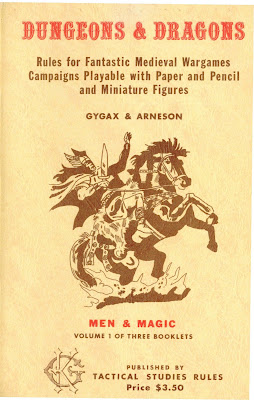
Dungeons and Dragons, Chainmail & Outdoor Survival - The Intersection of Wargame, Boardgame and the RPG Ur-Text
Sunday, February 6, 2022
Dungeons & Dragons (Holmes) Basic Set - Beginnings of the Friendly RPG
 |
| Cover to Holmes Basic Book by David C. Sutherland III |
The Dungeons and Dragons Basic Set, released by TSR in 1977, was the first time a table top role playing game tried to break into the mainstream. Although role playing was already a few years old at this point, it was not an approachable game for the novice even by the standards of its day. Role Playing had evolved from wargaming and was still somewhat confined to that crowd after Original Dungeons & Dragons had been released. One admirer of the D&D game was a physician and neurologist named John Eric Holmes. He approached TSR and offered to consolidate the existing ruleset into something more approachable for new and younger players. Gary Gygax accepted his assistance, as Gygax was developing Advanced Dungeons and Dragons in order to move away from the unstructured nature of OD&D but realized the benefit of having a less complicated game to introduce new players into the concept of role playing games.
Holmes compiled a manuscript which turned into a 48-page booklet, which was put in a colorful box with a module or supplementary dungeon building material and a set of polyhedron dice which was released in 1977 as the Dungeons and Dragons Basic Set. Intended to be only an introductory product to help players understand how to play and run an RPG, it proved to be very popular and spawned many successors. For several years it was one of TSR's most popular products, selling upwards of 12,000 copies per month by 1980. But is it playable today when those successors are as easy to find and buy? Let's take a look on how Holmes' distilled OD&D and presented it as a game in comparison with the later versions of the Basic Set.
Tuesday, January 11, 2022
Dark Shadows - The Complete Original Series Review
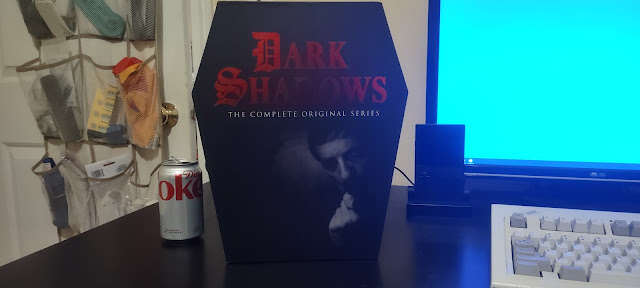
Dark Shadows is a landmark of classic television, introducing the concept of a supernatural, gothic horror soap opera to daytime television. The series ran for 1,225 22-minute episodes from 1966-1971. While I could wax on all day about the history of Dark Shadows and its significance, and have in the past, there are other sites on the internet which can do that in a more knowledgeable manner. Today I am hear to talk about the epitome of Dark Shadows, the Complete Original Series boxset (DS:COS) and offer my review of it.
Friday, December 24, 2021
Packard Bell : PC-Compatibles for the Masses, 1990s Style

In the history of personal computing, we often discuss the great pioneers who brought digital computing from the universities and the state to ordinary people, companies like Apple, Tandy, Commodore, Atari. These companies, which had big successes in the late 1970s and through the mid 1980s, did succeed in exposing millions of people to computer technology. But these non-PC compatible computers did not become ubiquitous household items, they were very expensive and offered little assistance for day-to-day non-business activities. The PC became dominant in the late 1980s in the US market and not too many years afterward in the rest of the world. One of the key players in that success was Packard Bell, and in this blog post I will talk about the company and my recent experience with one of its PCs.
Sunday, December 19, 2021
Nintendo Board and Chip Manufacture and Third Parties
I have often read that Nintendo, as of the Nintendo Entertainment System and everything thereafter, made all cartridges for its systems and required third parties to buy chips, board and other raw materials from them in order to have their software run on Nintendo's systems. While this was often true, the rule was not an absolute one and at times exceptions were made.
Nintendo does not make anything, it does not construct silicon wafers, it does not extrude plastic into molds, it does not own factories or fabrication plants which do these things. Nintendo designs and patents chips and products, but turning those designs into reality is a function of contractors. Obviously Nintendo has to work closely with those contractors to ensure its designs can translate into workable devices, but it is not correct to say that Nintendo really "made cartridges". In this article we will look at instances where Nintendo permitted third party cartridges to be made.